Business
Beyond OFW Remittances and BPO: Why Tourism, Manufacturing, and Boracay’s Infrastructure Are Critical To The Philippine Economy

By: John Dela Cruz
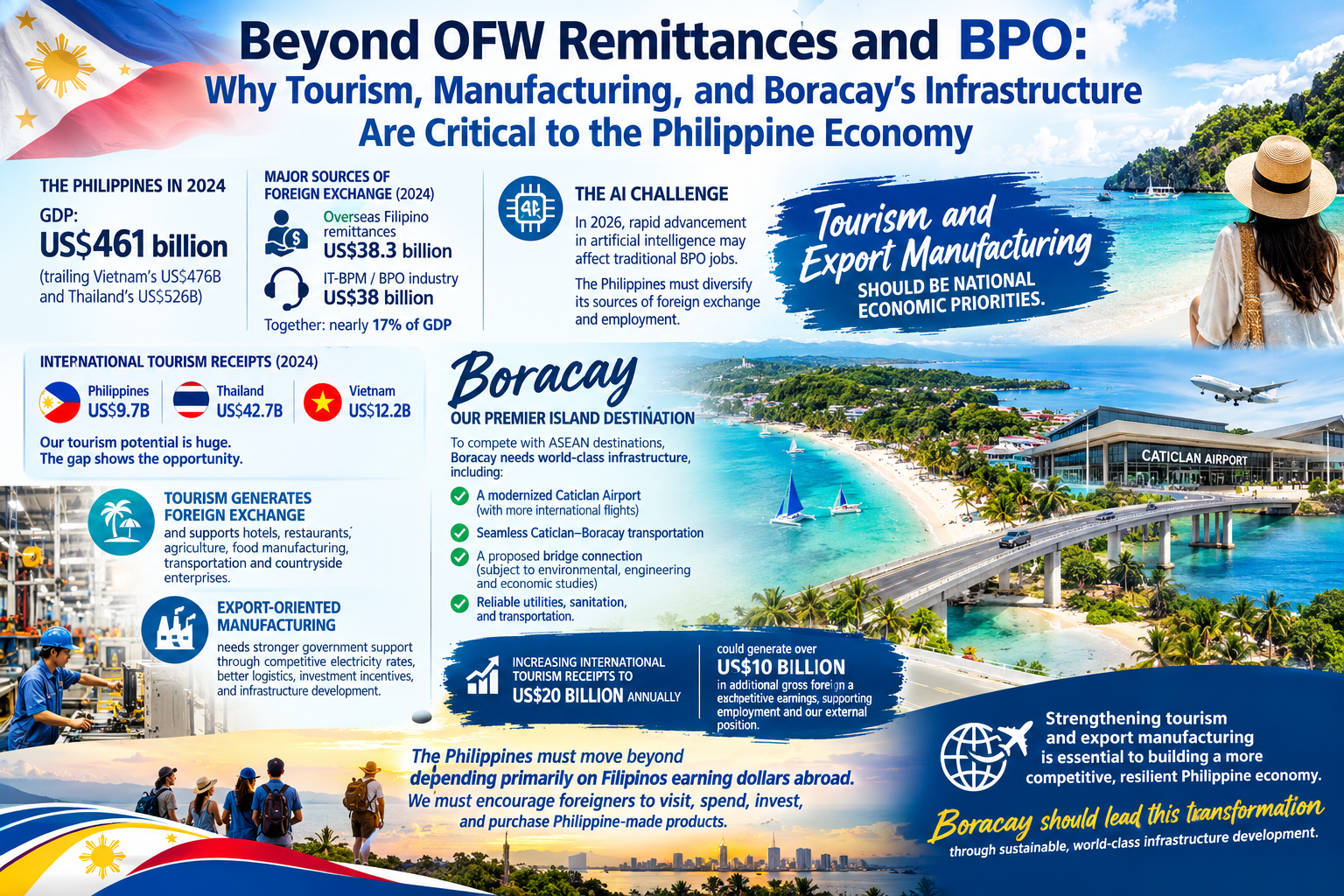
In 2024, the Philippine economy generated US$461 billion in GDP, trailing Vietnam’s US$476 billion and Thailand’s US$526 billion. Despite our economic potential, we continue to depend heavily on overseas Filipino remittances and the IT-BPM/BPO industry as major sources of foreign exchange.
Overseas remittances contributed approximately US$38.3 billion, while the IT-BPM industry generated US$38 billion in revenues. Together, these represent economic flows equivalent to nearly 17% of GDP.
However, the rapid advancement of artificial intelligence in 2026 presents growing risks to traditional BPO employment. Automation and robotics may eventually affect overseas job opportunities. The Philippines must diversify its sources of foreign exchange and employment.
Tourism and export manufacturing should become national economic priorities.
In 2024, Philippine international tourism receipts reached approximately US$9.7 billion, compared with Thailand’s US$42.7 billion and Vietnam’s US$12.2 billion. This enormous gap highlights our untapped tourism potential.
Boracay, our premier international island destination, illustrates both the opportunity and the challenge.
To compete with neighboring ASEAN destinations, Boracay needs world-class infrastructure, particularly a modernized Caticlan Airport capable of handling more international flights and seamless transportation between Caticlan and Boracay.
A proposed bridge connection deserves serious consideration, subject to comprehensive environmental, engineering, and economic studies. Improved accessibility, reliable utilities, sanitation, and transportation would strengthen Boracay’s international competitiveness.
Tourism generates foreign exchange while supporting hotels, restaurants, agriculture, food manufacturing, transportation, and countryside enterprises.
Likewise, export-oriented manufacturing must receive stronger government support through competitive electricity rates, improved logistics, investment incentives, and infrastructure development.
Increasing international tourism receipts to US$20 billion annually could generate over US$10 billion in additional gross foreign exchange earnings, supporting employment and our external economic position.
The Philippines must move beyond depending primarily on Filipinos earning dollars abroad. We must encourage foreigners to visit, spend, invest, and purchase Philippine-made products.
Strengthening tourism and export manufacturing is essential to building a more competitive, resilient Philippine economy. Boracay should lead this transformation through sustainable, world-class infrastructure development.