Commentary
Aklan’s Drinking Water : An Impending Water Crisis

by John Dela Cruz
Aklan is blessed with rivers, rainfall, and abundant natural resources. Yet a troubling question confronts our communities: Why do so many households depend on commercially purchased drinking water?
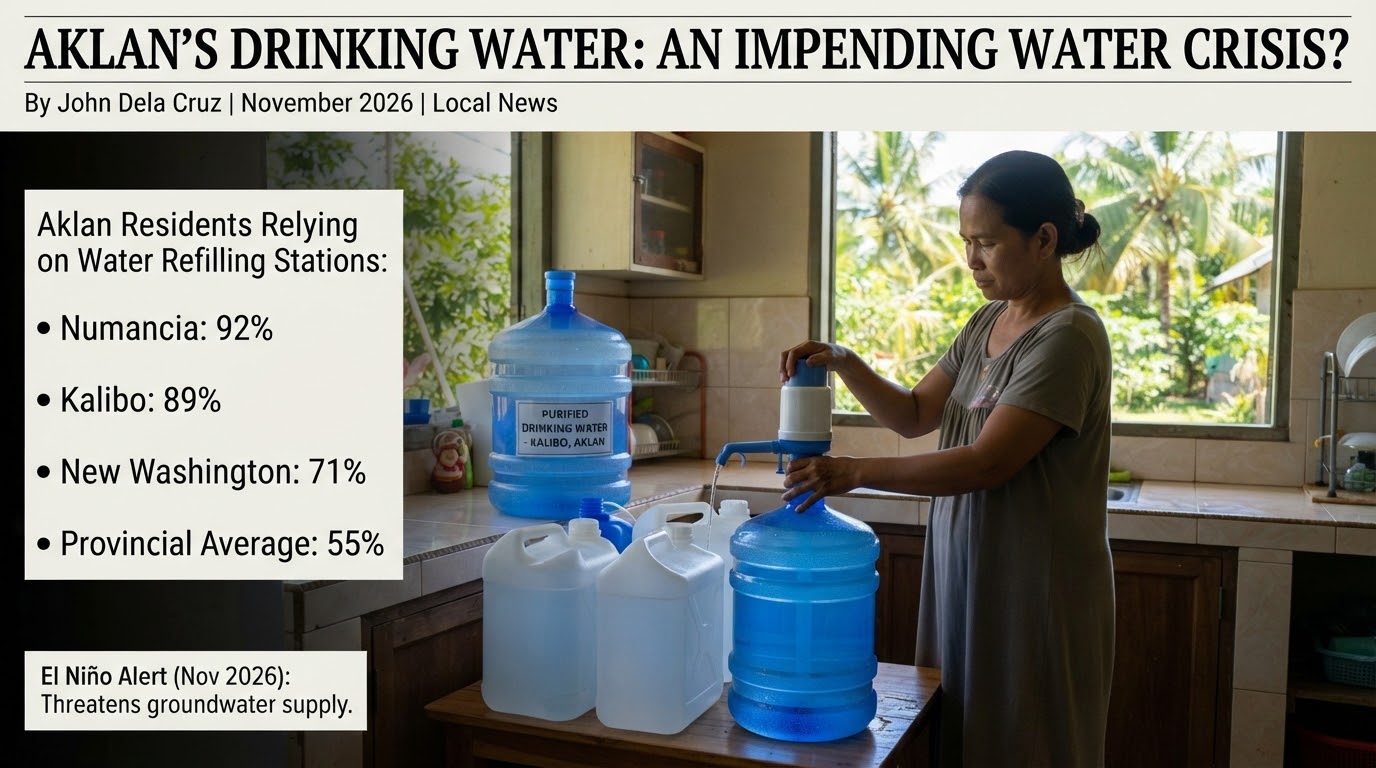
According to locally verified 2024 data, approximately 55% of Aklan residents rely on water refilling stations. Dependence is particularly alarming in Numancia at 92%, Kalibo at 89%, and New Washington at 71%.
This is not an isolated provincial concern.
The Philippine Statistics Authority’s 2024 Annual Poverty Indicators Survey reveals that 57.9% of Filipino families obtain drinking water from refilling stations, while only 17.2% use water piped directly into their homes as their drinking source.
More significantly, only 53.1% of families have access to safely managed drinking water under the PSA’s survey classification.
A 2026 Philippine Institute for Development Studies report estimates that 12.4 million Filipinos lack safe water, while 332 municipalities remain classified as waterless. Across 532 water districts, demand consistently exceeds effective supply.
The Department of Environment and Natural Resources also warned in March 2026 that approximately 40 million Filipinos lack reliable water supply.
These findings suggest a national infrastructure challenge involving water treatment, distribution, groundwater management, and public confidence.
Now comes another threat.
PAGASA confirmed a very strong El Niño in November 2026, potentially extending into 2027. Reduced rainfall could further strain groundwater resources and threaten households, agriculture, tourism, and businesses.
Water refilling stations provide an essential service, but their widespread use should prompt serious examination of our public water systems.
Are we investing sufficiently in safe, affordable, and dependable household water supply?
Aklan needs a comprehensive provincial water security plan involving local governments, water districts, businesses, and communities.
Priorities should include groundwater assessment, improved treatment and distribution, watershed protection, water storage, and drought preparedness.
Water security is not merely an environmental concern. It is fundamental to public health, economic development, and household welfare.