Lakbay Museo instantly brought me back to the days of Nayong Pilipino from 2007 to 2015—an iconic part of my childhood that made me fall in love with Filipino culture. As a child from Kalibo, Aklan, spending summers in Manila with my mother, Nayong Pilipino was our go-to place because it offered us an affordable way to explore the country without leaving the city.
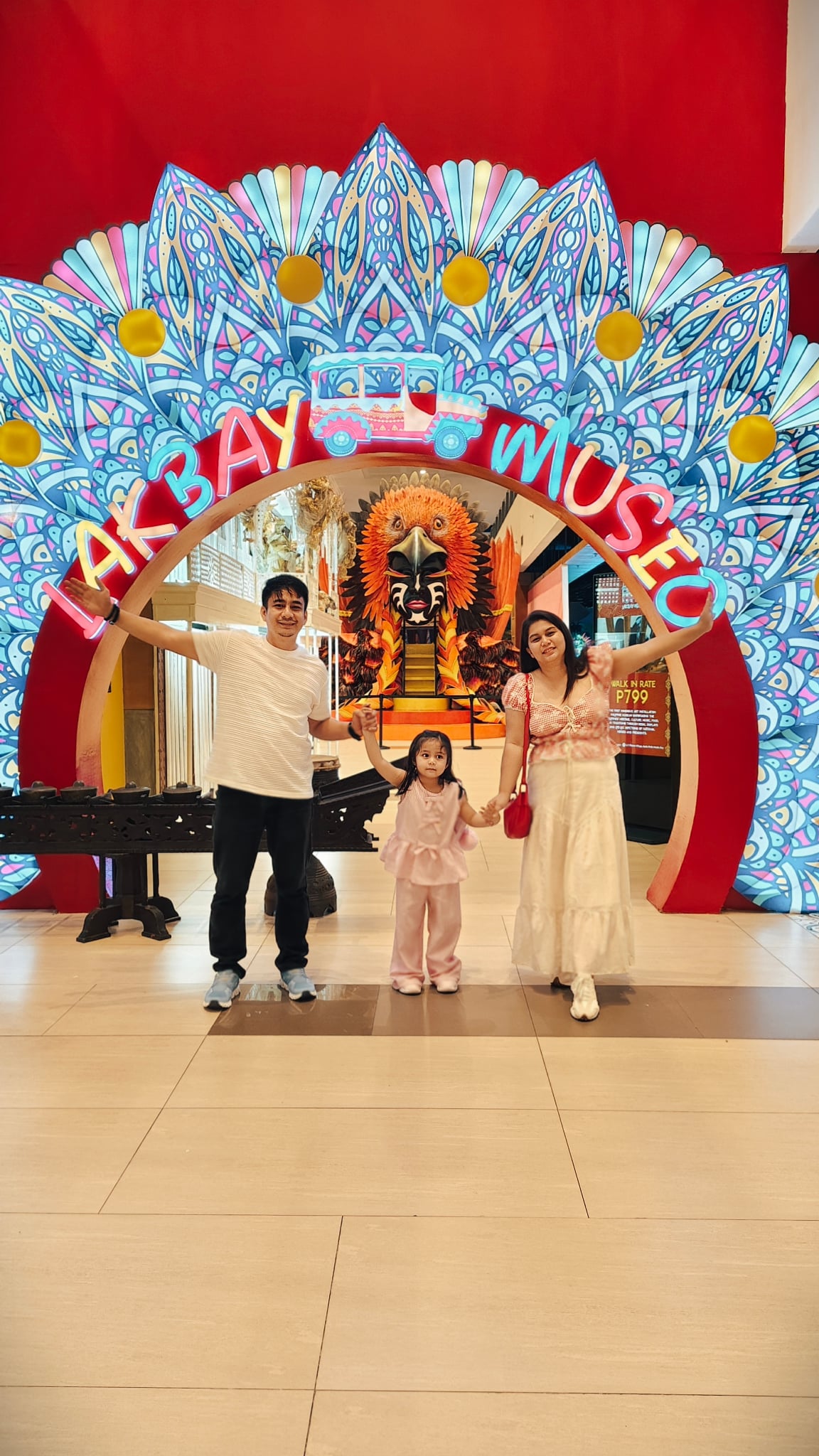
Today, years later, my husband and I brought our four-year-old daughter Brie to Lakbay Museo at Ayala Malls Manila Bay. It was her first time in Manila, and we wanted to give her a family-friendly, educational, unforgettable, and fun experience.
Ticket counters of the museum welcome visitors with street food displays, and right at the entrance, two exciting photo-ready options await: a colorful Ati-atihan-inspired welcome arch with a slide and a life-size jeepney. As the iconic symbol of Manila’s everyday life, the jeepney, complete with passenger seats, serves as the perfect photo spot and an early hint at the cultural immersion that lies ahead.
Immediately inside, a strawberry-themed treehouse echoes the quaint charm of Baguio, standing beside a replica of Mayon Volcano, which is widely known for its near-perfect cone shape and majestic presence, and leads to a kaleidoscope-lit tunnel. Living statues of national heroes like Lapu-Lapu, Jose Rizal, and Andres Bonifacio stand proudly in tribute to history.
For kids, there is a vibrant arts and crafts station with free activities such as coloring pages featuring jeepney, “bahay kubo,”halo-halo, and Pinoy street food, plus free “chicharon” and fish cracker snacks with a variety of local dips. Paid booths offer fun, hands-on experiences like slime-making, cooking street food (“fishball,” “squidball,” and “kikiam”) and delicacies (“bibingka” and “puto”), and plaster art painting of masks and various designs.
A real mini farm houses chickens, pigs, goats, and ducks that are all visible behind low fences for great photos. There is also an aquarium that features baby hammerhead sharks and different fish, while nearby terrariums and cages display turtles and crablets, hedgehogs, and friendly rabbits and hamsters that kids can pet.
For the adventurous, there is a section with edible worms that serves as a daring treat for the curious. Visitors can also try on pintados attire of Tacloban, Leyte, and take pictures beside mannequins in tribal costumes.
The “perya” or carnival area adds playful excitement with classic Filipino games like the “color game” that everyone loves. Winning gives you treats like OSH! (Oh So Healthy!) snacks, and my green bet scored us sour cream chips. There is also an engaging memory game to challenge young minds and their critical thinking skills, plus photo areas of angel wings for both adults and children.
In the next section, the “palengke” or market zone comes to life with “taho,” “sorbetes” or “dirty ice cream” pushcarts, and even a free shot of “lambanog” or coconut wine—a “tagay” or drinking session true to Filipino festivities. Nearby, visitors will find a massive “Itlog ni Kuya”, a merry-go-round horse, a pineapple chair, and a giant carabao they can hop on while wearing colorful hats. It makes for the perfect photo opportunity, as if taken during the Pahiyas Festival in Lucban, Quezon. The area also features a vibrant display of festival costumes from Bacolod’s MassKara Festival.
Then comes the underwater zone, featuring Mega Sardines video screens endorsed by Piolo Pascual, a small slide with a sand-based drop, and a photo booth with a mermaid tail. Next to it is a stunning mirror room and flower backdrop atop colored glass, a dream for photo lovers that replicates the 10,000 roses in Cebu. Beside this is a long banquet table with roasted lechon, Cebu’s most delicious food, leading to a replica of Magellan’s Cross where guests can freely play bamboo wind instruments.
Just before exiting, visitors see busts of all Philippine presidents from Emilio Aguinaldo to Ferdinand Marcos Jr., and a majestic Mindanao-themed stage where a cultural dance presentation highlights Muslim traditions. Here, the Lakbay Museo team puts on an energetic cultural dance performance, and guests are invited to join the community dance—an experience our daughter Brie absolutely loved. We capped it off with videos of the Muslim polite hand gestures, the Department of Tourism’s “Love the Philippines” hand heart signs, and the Mabuhay wave.
What truly stood out were the Lakbay Museo staff, who are tour guides at heart and dancers by performance. They know our history, heroes and personalities, cuisine, dances, instruments, and they are also the performers, photographers, and energy-keepers throughout your visit.
So whether you are a family, a couple, or a barkada, Lakbay Museo is a must-visit for a phenomenal, hands-on journey across the Philippines—and without leaving Manila, too! A cultural adventure that is engaging, informative, and proudly Filipino.
Let us celebrate Filipino pride, all under one roof.