Agriculture
The Purple Gold Rush: Understanding the Craze Behind the Hype


by John Icamina
Across the Philippines and even in many parts of the world, few agricultural products have captured attention as dramatically as ube (purple yam). Once considered an ordinary backyard crop and a staple ingredient for traditional Filipino delicacies, ube has now become a global culinary sensation.
From Manila to New York, Dubai, Sydney, and London, chefs, bakers, and food enthusiasts have embraced ube for its vibrant purple color, unique flavor, and versatility in desserts, beverages, pastries, and specialty food products. Social media has further amplified its popularity, turning ube into one of the most recognizable Filipino food ingredients worldwide.
The growing international demand has created new opportunities for farmers, processors, and agribusiness entrepreneurs. Many have begun planting ube in hopes of benefiting from its increasing market value. However, alongside this opportunity comes a growing concern: the spread of unrealistic expectations and, unfortunately, agricultural scams.
In recent years, stories have circulated promising extraordinary profits from ube farming, often accompanied by exaggerated claims about guaranteed buyers, miracle planting materials, or unrealistic production projections. As a result, some farmers and investors have spent substantial amounts on planting materials and questionable schemes, expecting instant fortunes.
The reality is that agriculture remains a long-term endeavor that requires patience, proper management, and an understanding of the crop’s biology.
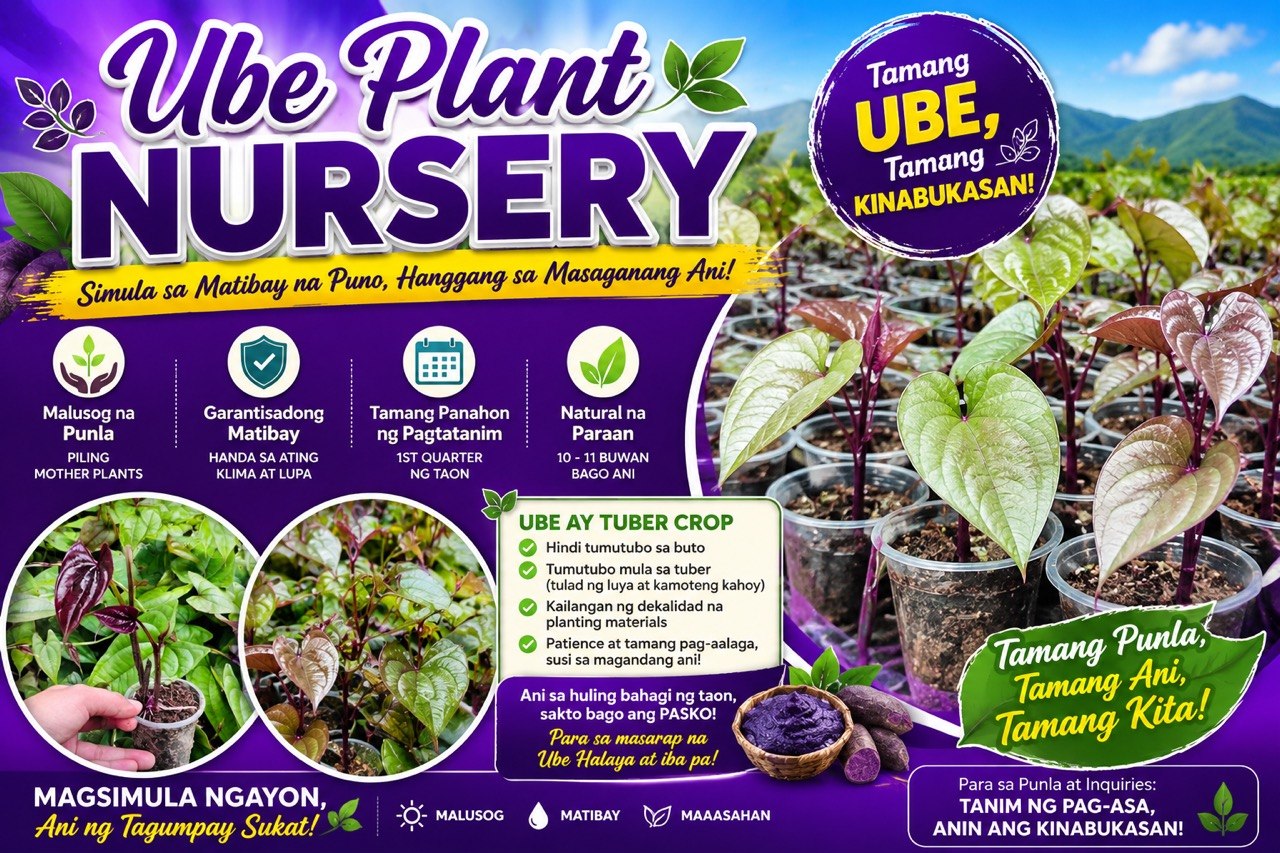
Unlike many vegetables and field crops, ube follows a natural growing cycle that cannot be rushed easily. The crop is normally planted during the first quarter of the year and requires approximately 10 to 11 months of growth before harvest. This means that farmers who plant early in the year generally harvest toward the final quarter, just before the Christmas season.
This timing is not accidental. For generations, the harvest season has coincided with the period when Filipino families prepare traditional delicacies such as ube halaya, making fresh ube most available during the holiday season. Nature itself has aligned the crop’s production cycle with one of the country’s most important culinary traditions.
Another challenge facing the industry is the availability of planting materials. Many people assume that ube can be propagated from seeds like corn, rice, or vegetables. In reality, ube is a tuber crop, similar in propagation to ginger and cassava. Farmers traditionally plant portions of tubers or specialized planting materials derived from the mother plant.
Because of this unique characteristic, the supply of quality planting materials often becomes a bottleneck whenever demand for ube rises. Producing enough planting stock takes time and requires sacrificing a portion of the harvest that could otherwise be sold for consumption.
Looking ahead, science may provide solutions. Researchers and agricultural institutions are exploring tissue culture and other advanced propagation technologies that could eventually produce large quantities of disease-free planting materials. Once these technologies become commercially viable, they may help expand ube production while improving plant quality and uniformity.
Until then, farmers should exercise caution when evaluating offers that promise quick riches or unlimited supplies of planting materials. Sustainable success in ube farming will come not from speculation but from sound agricultural practices, reliable market development, and responsible investment.
The current ube boom is a welcome opportunity for Philippine agriculture. It highlights the growing global appreciation for Filipino food and creates new income possibilities for rural communities. However, as with any agricultural trend, enthusiasm must be balanced with knowledge.
Ube is not a lottery ticket. It is a crop.
And like all successful crops, it rewards those who understand its nature, respect its growing cycle, and cultivate it with patience.
As the world continues to discover the rich flavor and cultural heritage behind this remarkable purple yam, let us ensure that the future of the ube industry is built not on hype, but on science, sustainability, and the hard work of Filipino farmers.