Commentary
On the Proposed Caticlan–Boracay Bridge



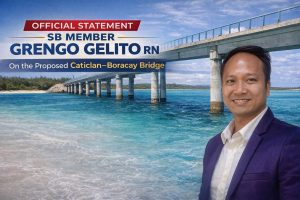
By: Malay Councilor Grengo Gelito
As a Member of the Sangguniang Bayan of Malay and Chairperson of the Committee on Public Health and Sanitation, as well as the Committee on Social Welfare, Senior Citizens, and Persons with Disabilities (PWDs), I would like to share my honest position regarding the proposed Caticlan–Boracay Bridge.
I understand that this project is currently being pursued as a national government infrastructure initiative. However, while the proposal may come from the national level, it is equally important that the voices of the communities directly affected particularly the people of Malay and Boracay are properly heard and considered.
From the perspective of public health and social services, I recognize that improved connectivity between the mainland and Boracay could bring certain advantages. A bridge could help improve emergency medical response, facilitate faster evacuation during disasters, and make travel easier for residents, especially for senior citizens and persons with disabilities who regularly move between the island and the mainland.
In addition, infrastructure of this scale could also help stimulate further development in mainland Malay. Compared to Boracay, the mainland has more available land and fewer environmental limitations, making it more feasible to expand infrastructure, logistics, and economic activities that can support tourism and other industries. With proper planning, mainland Malay has strong potential to become even more progressive in terms of development.
Because of these possible advantages, I was initially supportive of the idea of building a bridge.
However, after listening to stakeholders and reviewing the situation more closely, it became clear that there are still important concerns that need to be addressed.
First, there has been no formal endorsement yet from the Barangay Councils of Manoc-Manoc and Caticlan, which are the communities that will be directly affected by this project.
Second, there is still no clear livelihood transition plan for sectors that may be affected, particularly boat operators and transport workers who depend on the current jetty port operations. Development should uplift communities, not leave them uncertain about their future.
Third, there is no clear framework yet on how the economic benefits of the project will be shared among the national government, the provincial government, and the Municipality of Malay.
Fourth, the current proposal places the mainland entry point in the Municipality of Nabas rather than in Malay, particularly in the Tabon area which many stakeholders believe should also be seriously considered. Since Boracay is under the jurisdiction of the Municipality of Malay, it is only reasonable that our municipality be properly considered in the planning of its mainland connection.
Another important factor is environmental protection. Boracay has only recently recovered from a major rehabilitation that reminded us how fragile its ecosystem is. Any project of this scale must undergo a thorough and independent Environmental Impact Assessment to ensure that our marine and coastal resources are protected.
Let me be clear: I am not against development, and I am not completely rejecting the idea of a bridge. What I am calling for is careful planning, proper consultation, and responsible decision making.
Boracay is not only an asset of Malay, it is a national treasure and one of the most important tourism destinations in the country. Because of this, decisions that will affect its future must be made carefully, with the protection of our environment, our communities, and the livelihoods of our people in mind.
For now, I believe that supporting the project would be premature until these concerns are properly addressed.
Development is important, but it must always be responsible, inclusive, and sustainable.