Commentary
Ibajay’s Ati-Ati is Unique

(photo by: Jhay Ar Antayao)
Text By: Jun Barrientos Magpusao
Aklan is an Ati-Atihan province, with many of its towns celebrating it at various dates in this month of January culminating this Sunday (tomorrow) in Ibajay with its celebration called “Ati-Ati” in honor of its most beloved, the miraculous Señor Santo Niño de Ibajay
Aside from its name, what makes the Ibajay celebration unique?
1) The Devotion and Festivities Retain its Centuries-Old Original Name
The feast of the Señor Santo Niño in Ibajay is called “Ati-Ati,” the name given by the people when they started the devotion in 1569 and has been known as such ever since. According to the “Historia Sang Santo Niño Cag Ate-Ate,” a historical account written in 1975 with Ecclessiastical License by Msgr. Jose Iturralde, former Parish Priest of Kalibo, the celebrations in Malinao and Kalibo was also known by the same name when both devotions were established by Father Fernando de Legaspiin 1798 and 1800 respectively. Kalibo started using Ati-Atihan in the mid ’60s when the capital town changed the narrative of its origin to the Barter of Panay and started to promote it as a tourist attraction. Despite the passage of time and the popularity worldwide of the Kalibo festival, Ibayjanons maintain the name Ati-Ati with pride in honor of tradition, and of their fervent devotion to Señor Santo Niño represented by the miraculous image given to them as a driftwood, with the Holy Child’s face, caught by a resident (one account says he was a chieftain) in his fishnet in the Ibajay River.
2) The Ati’s Attire, Accessories and Movement While on the Streets Then and Now
I still recall that when I was a boy, the celebration of the Ati-Ati was very simple. On vesper and on the feast day itself, Ibayjanons, dressed simply in old clothes (the older, the better like “gunit” or torn clothing, and even sackcloth) with their faces smeared with soot. Each would troop to town, carrying a bamboo or wooden pole with “inasae” or roasted fish or chicken tied on top and adorned with leafy twigs, normally “pasao” (local name of San Francisco plant, scientific name: Codiaeum variegatum). The next day, the “Atis” with the pole with the “inasae” and “pasaw” and still dressed similarly as the day before group by barangay and parade around town while singing an old Ati-Ati ballad that starts with “Ati-Ati sa daeanas” (unfortunately, I could no longer remember the lyrics but the tune still reverberates in my mind). Since the song is slow but merry, the steps were also slow but in synch with the beat of the song. Once in a while, someone among the group would shout “Viva kay Señor Santo Niño!” after which the group responds “Viva!”
In those times, there were yet no loud drums (snare, bass, triple, etc.) and lyres we have these days. We only have the bamboo “kalungkong” and crudely made small drums made from dried hide for percussions and bamboo “hunghong” and plauta for the wind instruments that were used as accompaniment to the singing of the ballad.
The local folks called the movement of the Ati-Ati participants as “sayaw” (pronounced in “malumay” voice). They would say upon seeing the Ati-Ati moving on the streets “Naga sinayaw ro mga Ati.” (The Atis are gaily moving.)
The “sayaw” movement later on morphed into a “sadsad” movement (a fast forceful sliding forward movement where the toes and the front of the feet is somewhat controlling the move) to be in synch with the fast beat of the drums.
Nowadays, organized Ati-Ati groups, especially those joining the competition, are dressed in uniform costumes made from indigenous materials that are available in their respective localities. Although lacking in color like what we see in the Ati-Atihan, we can see in the designs and materials used the creativity and ingenuity of the designers. The groups also have their choreographer tasked to plan and execute the movements and routines of the participants while moving on the streets which are a delight to see.
Notwithstanding the changes, Ibayjanons maintained the fervor of the devotions and love for the Santo Niño as could be seen during the “Pagsaylo” considered as the highlight of the fiesta.
3) The “Pagsaylo” or Transfer of the Image of the Santo Niño
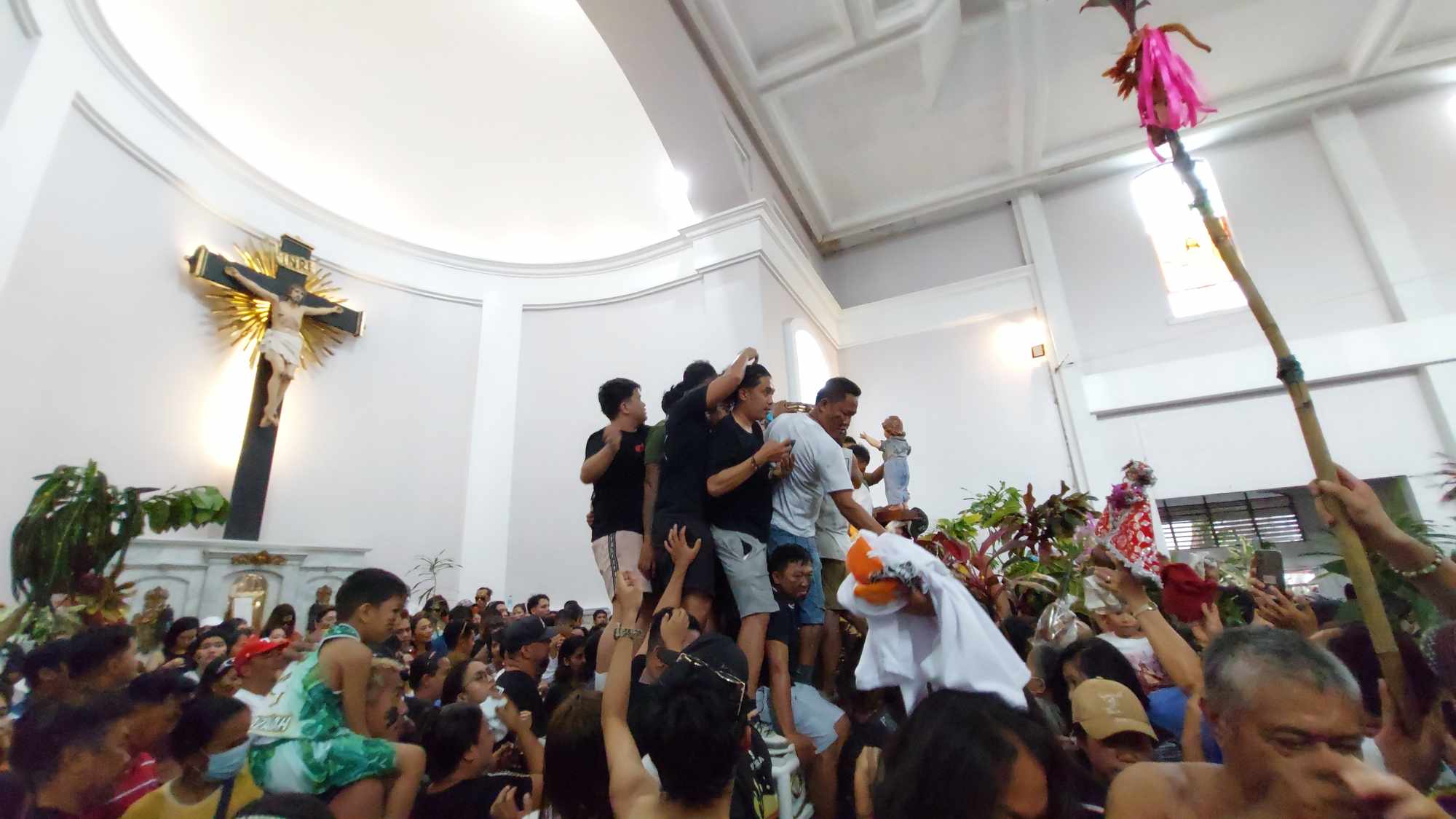
On vesper, the residents and devotees from other places gather in front of the convent or rectory patiently waiting for the image of Señor Santo Niño de Ibajay to emerge from the rectory’s door so they could welcome the image with extreme joy. (Gahueat sa pag aeaw-aeaw kay Señor Santo Niño.) As soon as they see the image of the Santo Niño de Ibajay in a glass casement coming out, shouts of joy and the beating of drums become louder and the people started to move. They then accompany the image, with the pall bearers shielding the glass casement and led by the Sayao, into the church for enthronement. At this instance, the atmosphere both outside and inside the church is like a pandemonium because of the intense shouts of joy of everyone joined by the booming beats of drums and lyre. Despite the defeaning sounds of the drums, shouts of “Viva Señor Santo Niño” would reverberate inside the church, especially at the moment of enthronement.
4) The “Sayao” an Essential Part of the Ati-Ati
The Sayao is a unique feature that is an essential part in the Ibajay celebration. It is a reenactment of the encounters of Ibayjanon Christian defenders with the pirates or sea bandits that would come ashore. They attributed their final victory to the Santo Niño. According to the story, a good looking young boy, a toddler, was seen walking along the shore shining very brightly accompanied by a loud noise that deterred the pirates from landing ashore.
While performing the Sayao, the participants wear costumes, black for Christians and red for the marauding pirates. Each holding a “taming” (shield) in one hand as they perform the “eskrima” (fencing) with the Christians holding a “bangkaw” (spheres) in another hand and “kampilan” (bolo-like weapon) for the pirates. They also recite a “Luwa” (verses) that narrates the history of the Sayao and its significance to the Santo Niño celebration.
5) The “Caro” (Floats) that Accompany the Atis
The Ati-Ati parade is participated by the town’s barangays accompanied by a float adorned and bedecked with and showcasing the barangay’s produce, its craft, or its source of livelihood. The floats are moving displays of the source of pride of each barangay. The “caro” in the Ati-Ati parade may have been an addition to the celebration. In my seven decades as an Ibayjanon, the “caro” of each barangay has never failed to amaze me.
Again, creativity and enginuity are clearly manisfested in the designs and craftsmanships of the float.
6) The “Pasaw as a Regular Fixture
The use of the twigs of “pasaw” or San Francisco plant had also become an essential part of Ibajay’s celebration. You can see the different varieties of this plant either directly carried by hands or part of the adornment tied to a wooden or bamboo poles. The devotees raise or wave what they are holding when they welcome or praise the Señor Santo Niño.
Nowadays, however, devotees also use other plants for this purpose.
7) Barangay Aquino Consistent with their Identity in Its Participation
Barangay Aquino, a seaside barangay west of the Poblacion and the last barangay before the town of Nabas has its name always inscribed using its marine products such as crabs, prawns, shrimps and fish to form the name of the barangay and to adorn their float.
These realities separate the Ibajay Ati-Ati from the celebration of other towns who also have devotion to the Santo Niño, making the Ibajay Ati-Ati unique. I hope that our younger generations of Ibayjanons who will inherit this devotion will preserve and protect this heritage.
Viva Señor Santo Niño! Viva Señor Santo Niño! Viva Señor Santo Niño!