Commentary
Why Kalibo International Airport is Losing Its Grip?

By Dr. Jimmy B. Maming
For decades, Kalibo International Airport was the undisputed heavyweight champion of
Boracay tourism. But today, its runways are growing quiet, leaving a haunting question: How did
the region’s premier gateway lose its grip to a rival airport just minutes from the beach?
The decline of Kalibo International Airport (KIA) marks a dramatic shift in Western
Visayas aviation. What was once the primary lifeline for millions of sun-seeking travelers has seen
a massive drop in operations, with domestic routes drastically dwindling and local airfares soaring.
To understand this structural shift, we must look at the airport’s internal dynamics and how the
government can pivot to save it.
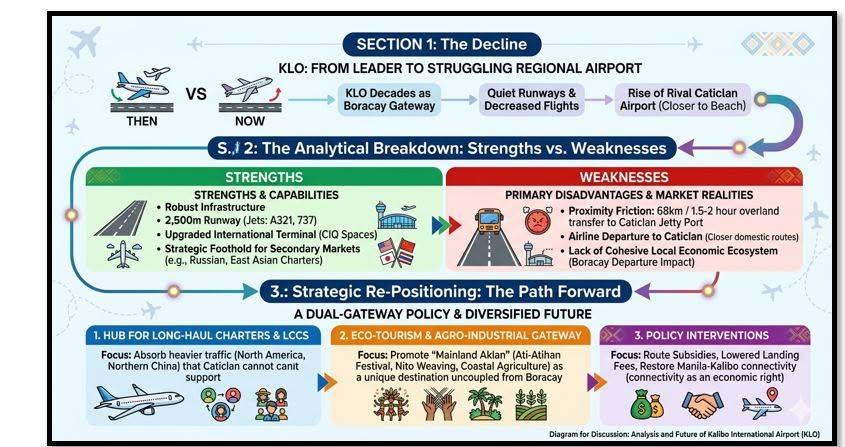
The Analytical Breakdown: Strengths vs. Weaknesses
An objective look at Kalibo’s current position reveals an airport caught between structural
capability and shifting market realities:
Kalibo International Airport (KIA) possesses a robust, established infrastructure that
Caticlan historically lacked. It features a long 2,500-meter runway capable of handling larger,
narrow-body jetliners like the Airbus A321 and Boeing 737 without payload restrictions. Thanks
to historical “Build, Build, Build” upgrades, its international terminal can process hundreds of
passengers simultaneously, boasting designated spaces for Customs, Immigration, and Quarantine
(CIQ) teams. Furthermore, it retains a strategic geographical foothold for secondary international
markets, recently welcoming charter flights from unique origins like Irkutsk, Russia, alongside
traditional East Asian routes.
But the above salient points have its own share of weak points. Conversely, its primary
disadvantage is proximity friction. Located 68 kilometers away from the Caticlan jetty port,
landing in Kalibo requires a grueling 1.5 to 2-hour overland transfer. Once Caticlan Airport
extended its own runway to accommodate jet aircraft, airlines rapidly moved their domestic
operations to eliminate this commute. Additionally, the lack of a cohesive, localized economic
ecosystem means that when Boracay traffic left, Kalibo’s commercial viability fell sharply.
Strategic Re-Positioning: The Path Forward
To prevent Kalibo International Airport from becoming a multi-million-peso white
elephant, the national government and the Civil Aviation Authority of the Philippines (CAAP)
must stop treating it as a backup Boracay transit point and pivot toward a dual-gateway policy.
First, the government should position KIA as a dedicated hub for long-haul international
charters and low-cost carriers (LCCs). Caticlan’s geographic footprint limits its terminal
expansion and air traffic capacity; Kalibo can absorb the heavier, long-distance wide-body traffic
from North America, Russia, and northern China that Caticlan cannot efficiently support.
Second, the local government must uncouple Kalibo’s economy from Boracay. Kalibo
is the provincial capital of Aklan, possessing its own unique cultural identity through the world
renowned Ati-Atihan Festival, a resilient nito reed weaving industry, and rich coastal agriculture.
By packaging the airport as the gateway to “Mainland Aklan Eco-Tourism” and agro-industrial
trade, rather than a mere pitstop to the beach, the government can stimulate regional business travel.
Finally, policy interventions such as targeted route subsidies and lowered landing fees
must be deployed immediately to entice domestic carriers back. Restoring regular, affordable
flights to Manila is vital to ensuring that connectivity remains an economic right for the people of
Aklan, rather than a luxury line abandoned to market forces. To better understand my points.
_________________
About the Writer
Dr. Jimmy B. Maming is a distinguished scholar, researcher, and academic administrator
dedicated to driving transformative leadership and change within a VUCA world. A true polymath,
Dr. Maming holds four doctoral degrees, including a PhD in Management, a Doctor of Public
Administration, a Doctor of Education in Educational Leadership and Management, and a Doctor
of Ministry in Christian Leadership. Further, Dr. Maming is an alumnus of Northwestern Visayan
Colleges; Kalibo, Aklan. His extensive academic foundation is further augmented by executive
programs at the Asian Institute of Management (AIM) and advanced master classes at the
University of the Philippines Los Baños and De La Salle University-Manila, focusing on
alternative dispute resolution, research teaching, leadership and Management. A prominent figure
in quality assurance and international accreditation frameworks, he previously served as the Head
of the Quality Assurance and Accreditations Department at AMA University and sat on the
National Board of the Association of Administrators in Hospitality, Hotel and Restaurant
Educational Institutions (AAHRMEI).