Latest News
PSA- Aklan Conducts Poverty Indicators Survey to Assess Families Living Condition

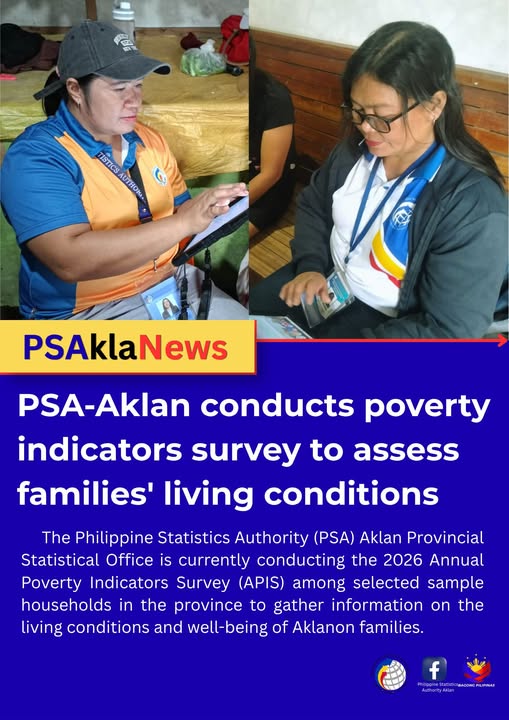
KALIBO, Aklan- The Philippine Statistics Authority (PSA) Aklan Provincial Statistical Office is currently conducting the 2026 Annual Poverty Indicators Survey (APIS) among selected sample households in the province to gather information on the living conditions and well-being of Aklanon families.
The APIS is a nationwide household-based survey designed to generate non-income indicators related to poverty.
Unlike the Family Income and Expenditure Survey (FIES), which measures household income and expenditure to estimate poverty, APIS complements FIES by providing information on other dimensions of poverty, enabling a more comprehensive assessment of the quality of life of Filipino families.
The survey collects information on various aspects of household welfare, including housing characteristics and ownership; school attendance and educational assistance; health and nutrition; children’s vaccination status; loans and sources of credit; receipt of benefits from selected social protection programs; community safety; access to government services; participation of children aged 0 to 4 years in Early Childhood Care and Development (ECCD) programs; parenting practices; food security; disaster preparedness and recovery; incidence of non-sexual harassment and violence; and utilization of the National ID.
Data generated from the APIS will also be used to produce indicators for monitoring the country’s progress toward the Sustainable Development Goals (SDGs), particularly Goal 1 (No Poverty), Goal 6 (Clean Water and Sanitation), and Goal 16 (Peace, Justice, and Strong Institutions).
According to Dr. Peter S. Mangilog, Officer-in-Charge of PSA Aklan, the survey recognizes that poverty extends beyond income alone.
“A family may have an income above the poverty threshold but still experience deprivation in education, health, housing, or access to basic services. By measuring these dimensions, APIS provides a more comprehensive picture of poverty and helps guide the formulation of evidence-based policies and programs that improve the lives of Filipino families,” Dr. Mangilog said.
Based on the preliminary results of the 2024 APIS, more than half (53.1%) of Filipino families had access to a safely managed drinking water service from an improved source, while 44.4 percent had access to a basic drinking water service from an improved source with a round-trip collection time of not more than 30 minutes. Meanwhile, the proportion of families with access to a limited drinking water service declined from 1.3 percent in 2022 to 0.9 percent in 2024.
The survey also showed improvements in sanitation. Access to a basic sanitation service increased from 84.0 percent of families in 2022 to 84.7 percent in 2024, while access to a limited sanitation service decreased from 10.8 percent to 10.1 percent during the same period. In addition, about 93.6 percent of Filipino families had access to a handwashing facility in 2024.
PSA Aklan encourages all selected sample households to actively participate in the survey and provide complete and truthful information.
All information collected will be treated with the strictest confidentiality and used solely for statistical purposes as provided for by law.