Commentary
Bleeding Capital

By: Dr. Jimmy Maming
Tourism is frequently championed as a catalyst for regional economic growth, yet its true
net benefit is often compromised by tourism leakage. As defined by Kim and Suh (2025), tourism
leakage represents the structural outflow of tourism revenue that fails to benefit local economies.
Instead of circulating within the host community to create a multiplier effect, tourist expenditures
escape the destination through specific globalized channels. This phenomenon poses a severe
threat to the economic sustainability of tourism-dependent regions, particularly when local
stakeholders fail to fully understand or mitigate its mechanisms.
The Mechanisms and Causes of Leakage
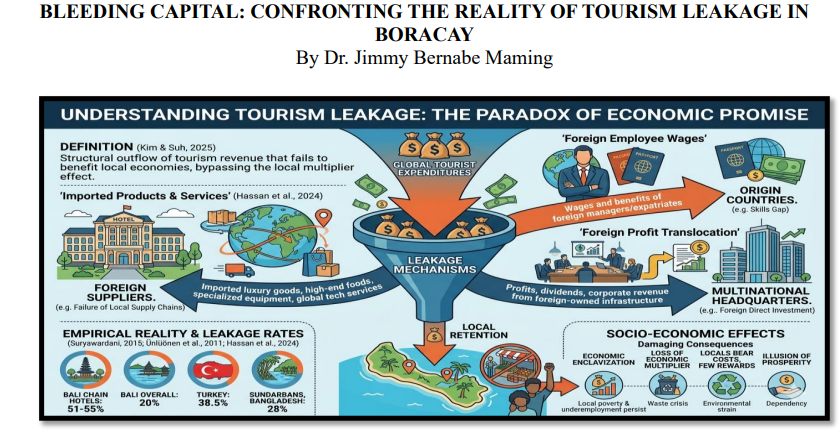
As identified by Hassan et al. (2024), leakage fundamentally operates through three
primary channels, each driven by specific structural causes:1) Imported Products and Services.
Destinations often lack the local supply chains required to meet the high-end demands of
international tourists. To maintain global hospitality standards, hotels and resorts import luxury
foods, beverages, and specialized equipment, sending revenue right back to foreign suppliers.2)
Foreign Employee Wages. A gap frequently exists between the specialized managerial skills
demanded by multinational hospitality brands and the qualifications of the local workforce.
Consequently, high-paying executive and technical positions are filled by expatriates who
repatriate their wages.3) Foreign Profit Translocation. Large-scale tourism infrastructure is often
financed by foreign direct investment (Suryawardani et al., 2014). While this brings rapid
development, the resulting profits, dividends, and corporate revenues are systematically
transferred out of the host country to overseas headquarters.
In destinations like Boracay Island in the Philippines, this issue has escalated primarily due
to a historical lack of structural understanding. When a destination undergoes rapid
commercialization without proactive policies to integrate local agriculture, fisheries, and
homegrown businesses into the tourism ecosystem, foreign-owned packages and all-inclusive
resorts naturally step in, intercepting the capital before it ever touches the local community.
The Empirical Reality and Socio-Economic Effects
The empirical evidence demonstrating the severity of leakage is robust across global
tourism hubs. Micro and macro-level research in Bali’s accommodation sector revealed an overall
leakage rate of nearly 20%, which drastically spiked to 51%–55% within higher-star international
chain hotels (Suryawardani, 2015). Similarly, Turkey’s tourism sector recorded a 38.5% leakage
rate (Ünlüönen et al., 2011), while community-based ecotourism in the Sundarbans of Bangladesh
still experienced a 28% drain of revenue (Hassan et al., 2024).
The effects of these high leakage rates are profoundly damaging. When half or more of
every tourist dollar exits the economy, the destination suffers from economic enclavization where
locals bear the heavy environmental and social costs of overtourism (such as rising living costs,
waste management crises, and strained infrastructure) while receiving only a fraction of the
economic rewards. This imbalance creates an illusion of prosperity; GDP metrics may rise due to
high tourist arrivals, but local poverty, underemployment, and economic dependency remain
stubbornly entrenched. Sublimely, this is exactly the reality of Boracay Island that needs to be
addressed.
Moreover, rapid tourism growth without proper planning, high cost of living causing
inflation, and environmental harm by local populations are potential causes of tourism leakage in
Boracay Island (Maming et. Al, 2021). Tourism leakage is caused by weak enforcement of
regulations, dominance of foreign-owned businesses, and minimal local community involvement
(Margayawati, 2025). This phenomenon requires a wakeup call first, to our lawmakers and to the
concerned stakeholders in the Municipality of Malay or we will just drain on the pipe our suppose
hard earned revenue and tourism benefits.