Latest News
DBM,DEPDev Move To Give Regions A Say Before 2028 Decisions Are Made

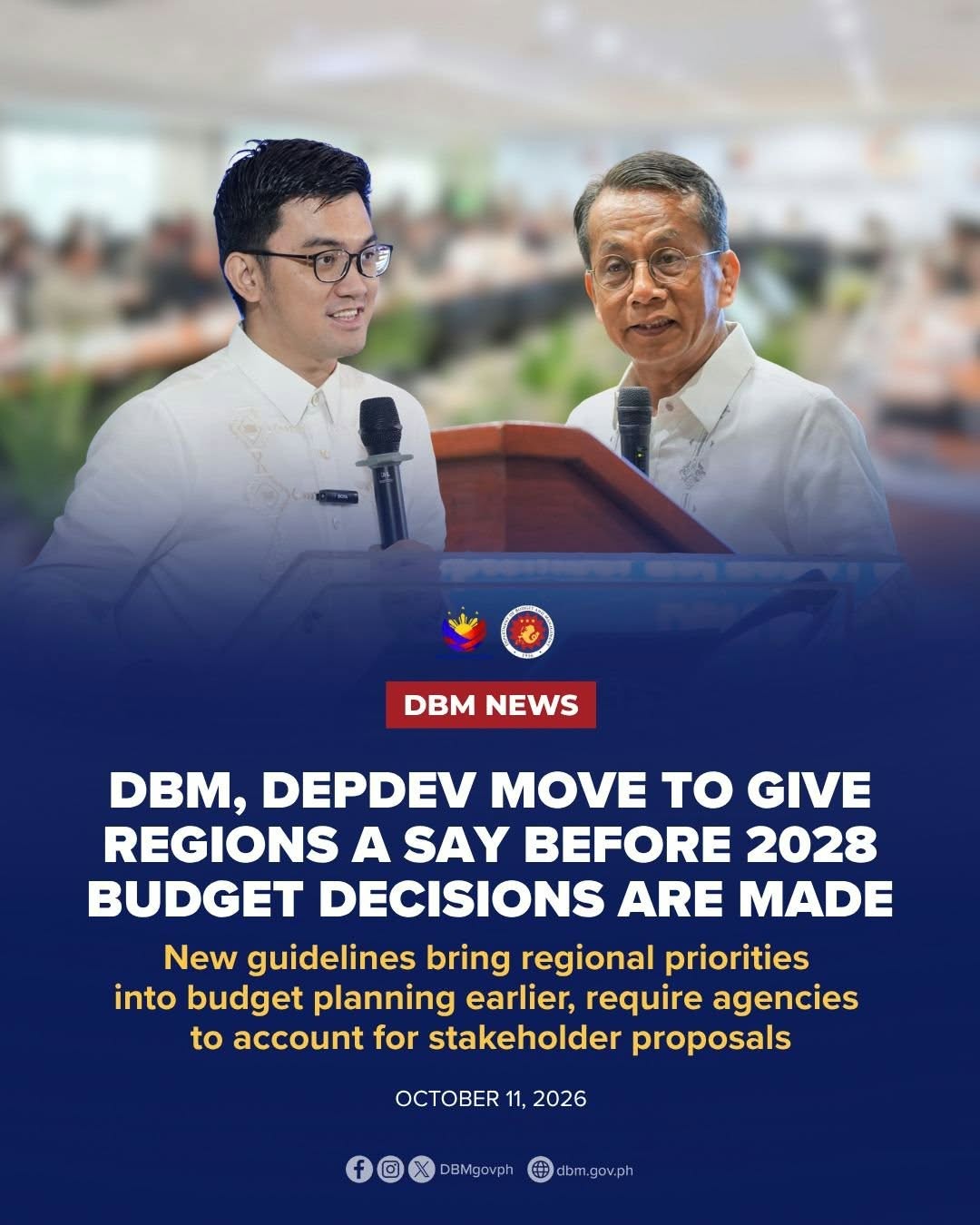
New guidelines bring regional priorities into budget planning earlier, require agencies to account for stakeholder proposals
PASAY City— Regional development priorities will have an earlier opportunity to influence national budget decisions as the Department of Budget and Management (DBM) and the Department of Economy, Planning, and Development (DEPDev) introduce new guidelines giving local communities and stakeholders a stronger voice in shaping government spending priorities for Fiscal Year (FY) 2028.
Under the new policy, national government agencies will engage Regional Development Councils (RDCs), local government units (LGUs), civil society organizations (CSOs), and other stakeholders even before the National Budget Call is issued, allowing regional proposals to be considered while agencies are still determining their budget priorities.
The reform also strengthens accountability by requiring agencies to explain how regional proposals were considered, including why certain projects were incorporated, modified, deferred, or not prioritized.
DBM Acting Secretary Kim Robert C. De Leon underscored this shift during the 4th Regional-National Investment Programming (RNIP) Dialogue held on September 24, 2026, in Pasay City.
“That is why regional voices must be heard before budget decisions are made—not after. Our RDCs, LGUs, and regional stakeholders are closest to the realities on the ground. You know where the gaps are,” Secretary Kim emphasized.
The policy is formalized through DBM-DEPDev Joint Memorandum Circular (JMC) No. 1, s. 2026, entitled Procedural Guidelines on Strengthening Participatory Governance and Regional Development Council Engagement in the Preparation of Agency Budget Proposals for FY 2028.
FROM REGIONAL NEEDS TO NATIONAL BUDGET PRIORITIES
The guidelines recognize that institutions closest to communities are often best positioned to identify pressing development needs, from classrooms and hospitals to roads, agricultural support, and other essential services.
Starting October 13, 2026, covered government agencies will undertake early priority-setting activities for their FY 2028 budget proposals, followed by regional stakeholder engagement, RDC review and prioritization, and agency-level consolidation of proposed programs, activities, and projects (PAPs).
The process will involve CSOs, LGUs, congressional district representatives, private sector organizations, academic institutions, development partners, beneficiaries, and sectoral groups, alongside RDCs and concerned national government agencies.
For example, when a region identifies the need for additional health facilities, school infrastructure, or transport connections, these priorities can be discussed with implementing agencies and assessed against national development objectives before budget proposals are finalized.
Importantly, regional participation will not end with submitting proposed projects. Stakeholders will also gain greater visibility into how their proposals are evaluated and acted upon.
MORE THAN CONSULTATION: AGENCIES TO EXPLAIN BUDGET PRIORITIES
While RDC endorsements and stakeholder recommendations will not automatically guarantee funding, agencies will provide greater clarity on how regional proposals influenced their final priorities.
Where appropriate, agencies will indicate whether proposed PAPs were incorporated, adjusted, deferred, not prioritized, or otherwise addressed, together with the corresponding justification.
National agencies will retain responsibility for determining their priorities based on development objectives, available fiscal resources, implementation readiness, and applicable budget requirements.
The objective is not to promise funding for every proposed project, but to ensure that regional needs receive timely, serious, and transparent consideration.
BETTER-PREPARED PROJECTS, BETTER USE OF PUBLIC FUNDS
Beyond strengthening participation, the initiative seeks to improve the quality and implementation readiness of government investment proposals.
During the September 24 dialogue, Secretary De Leon stressed the importance of closer coordination among DBM, DEPDev, RDCs, implementing agencies, and LGUs in identifying potential implementation challenges before budget proposals are finalized.
“This is where our partnership becomes critical. Together with DEPDev, the RDCs, implementing agencies, and LGUs, DBM must help identify these constraints earlier—not when the budget is already being finalized,” the Budget Secretary said.
Earlier coordination will help identify gaps in project preparation, technical requirements, and implementation capacity that could delay public investments.
Under the JMC, DBM Regional Offices will provide technical assistance on budget preparation policies and guidelines, while DEPDev will support regional development planning, investment programming, and RDC review and prioritization of proposed PAPs.
The guidelines cover departments, agencies, bureaus, offices, commissions, state universities and colleges, and other national government instrumentalities receiving appropriations under the General Appropriations Act.
Excluded are personnel services, statutory and mandatory obligations, routine administrative and operating requirements, and other PAPs not subject to regional planning and prioritization.
Once the FY 2028 National Budget Call is issued, agencies will finalize their proposals, taking into account regional engagement, RDC priorities, national development objectives, and applicable budget parameters.
The initiative forms part of broader public financial management reforms aimed at making national budget preparation more responsive to regional needs, transparent in prioritization, and focused on implementation-ready investments.
“For FY 2028 and the succeeding years, let us work together to build a stronger pipeline of regional investments—not merely projects that deserve funding, but projects increasingly prepared to use that funding well and deliver on time,” Sec. Kim emphasized.