Commentary
The Fossils Also Glorify God Who Made All Things Well Using the Process of Evolution



By: Raymond Sucgang
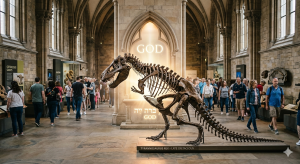
Every time I stand before the towering bones of a Tyrannosaurus rex in a museum, something inside me falls silent. The chatter of the crowd fades, the shuffle of footsteps disappears, and I am left alone with a presence that feels both distant and deeply intimate. I cannot help but stare–longer than most people do–drawn not only by the sheer size of the creature, but by the mystery it carries. It is not just a skeleton. It is a whisper from a world that no longer exists.
There is an overwhelming awe that rises in me, almost like a quiet prayer. How magnificent must this creature have been in its time, muscle, motion, breath, and power clothed over these ancient bones. Each rib, each tooth, each curve of its massive skull speaks of a design so intricate and purposeful that it is impossible for me not to think of the Creator. Not as an abstract idea, but as an Artist, one who shaped life in forms so grand that even their remnants command reverence millions of years later.
And yet, alongside that awe comes something deeper, something almost unsettling in its beauty. I realize that this giant once walked a world that I will never know, under skies that no human eye has ever seen. It lived, hunted, struggled, and perished long before the first human breath was ever drawn. There is a vast, immeasurable distance between its time and mine, a separation not just of years, but of entire realities.
Why was it so?
Why were we, as human beings, placed not alongside such giants, but in a completely different chapter of existence?
In that quiet moment before the fossil, I begin to feel the weight of time, not as a scientific measurement, but as a deliberate unfolding. It is as if the Creator wrote history in movements, each era carrying its own purpose, its own story, its own inhabitants. The age of the giants came and passed, not by accident, but with a finality that makes space for something new. And then, much later, came us, fragile, thinking, searching beings–placed not in the shadow of these creatures, but in a world shaped by everything that came before.
There is something humbling in that realization.
We are not the first, nor the largest, nor the most physically powerful beings to walk this Earth. And yet, we are the ones who can stand in a museum, gaze upon ancient bones, and wonder. We are the ones who can ask why. We are the ones who can feel awe, not just at the creature, but at the One who designed it.
And perhaps that is the point.
The separation of our existence from that of the great dinosaurs is not a loss, but a kind of gift. If we had lived among them, we might have only feared them, or taken them for granted. But instead, we encounter them as echoes, silent teachers reminding us of the vastness of creation and the depth of time. They draw from us a kind of reverence that only distance can create.
Standing there, I do not feel small in a diminishing way; I feel small in the right way. The kind of smallness that opens the heart, that makes room for wonder, that acknowledges something far greater than oneself. The bones of the Tyrannosaurus rex do not just tell me about a prehistoric predator. They tell me about a Creator who works beyond human timelines, beyond human understanding, and yet allows us to glimpse His work through these remnants of the past.
So I keep staring.
Not just at what the creature was, but at what its existence means. At the quiet truth that life has unfolded in ways far grander than I can comprehend. And at the mysterious, beautiful reality that I have been placed here–not in the age of giants–but in this moment, with the ability to look back, to feel awe, and to wonder at it all.