Commentary
Compassion at Whose Expense? The Moral Problem in the Lifeline Rate Subsidy Program

By: Leon Magpusai Jr
The government wants the public to see the Expanded Lifeline Rate Subsidy Program as an act of compassion. On paper, it certainly looks like one. Qualified beneficiaries of the Pantawid Pamilyang Pilipino Program (4Ps) who consume up to 50 kilowatt-hours a month are now entitled to a 100% discount on electricity, with the Department of Social Welfare and Development, the Department of Energy, and the Energy Regulatory Commission touting the measure as a concrete way of easing the burden of the poorest households. The policy has been presented as humane, practical, and overdue. It is easy to understand why. Electricity is no longer a luxury. It is part of modern survival. A family living on the edge should not have to choose between keeping the lights on and putting food on the table. The objective of helping the poorest households is therefore not the problem. The problem is how the government chose to pay for that help.
That is where the moral discomfort begins.
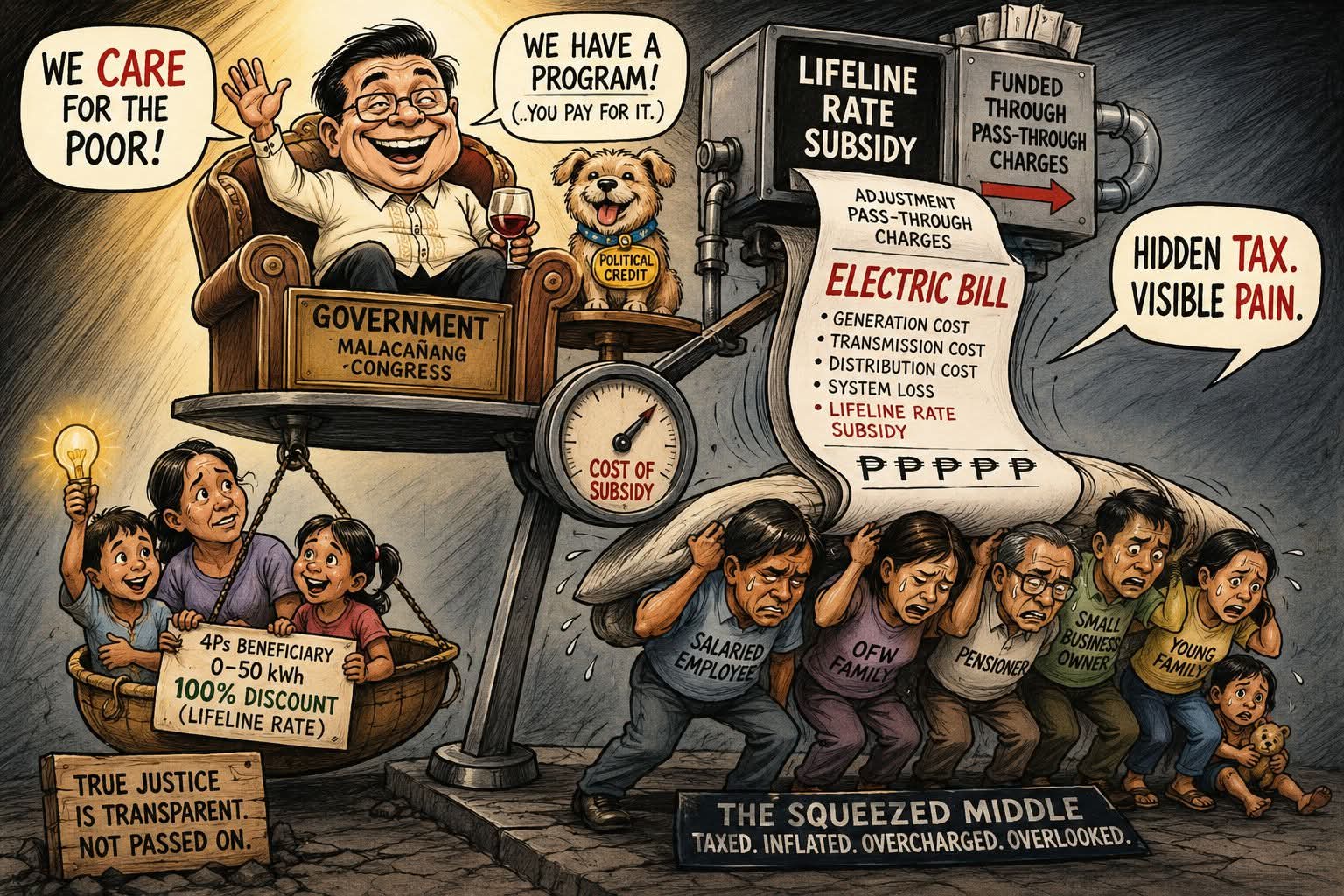
For all the lofty language about social justice, the subsidy is not chiefly being paid by the State from the national treasury. Instead, the burden is passed on to other electricity consumers through a cross-subsidy mechanism embedded in power bills. In plain language, the government is helping one struggling sector not by transparently appropriating funds from the budget, but by requiring another broad class of consumers to quietly shoulder the cost. Meralco itself has publicly explained that the lifeline rate is among the “pass-through” charges reflected in consumer bills and that these are imposed under the governing law and regulatory framework. In other words, the subsidy may be pro-poor in purpose, but it is financed in a way that feels distinctly anti-middle class.
This is the central flaw in the program, and it is not a small one. A government that wants to claim the moral credit for helping the poor should also have the honesty to bear the political cost of funding that help openly. If a subsidy is truly a public duty, then it should be paid for through the public budget – debated in Congress, justified before taxpayers, and accounted for with full transparency. What the present arrangement does instead is to shift part of that duty onto consumers who are themselves already drowning in a brutal cost-of-living environment. It asks the salaried employee, the pensioner, the small entrepreneur, the young couple paying rent, the household trying to keep a child in school, and the family caring for an elderly parent to absorb yet another charge in the name of social welfare. And it does so not as a visible tax debated in the halls of government, but as another line in a monthly bill that people are simply expected to swallow.
That is why the anger of ordinary consumers should not be dismissed as selfishness or class hostility. Much of it is rooted in something more fundamental: a sense of unfairness. The Filipino middle-income family is already the country’s most overused safety net. It pays taxes. It absorbs inflation. It shoulders tuition hikes, transport costs, medical bills, and utility increases. It is often too “comfortable” to qualify for government aid and yet too financially fragile to withstand one serious emergency. It is the segment of society that is repeatedly told to be resilient, responsible, and understanding, even as the economic system increasingly treats it as a bottomless reservoir of revenue. For many of these families, the Lifeline Rate Subsidy Program is not infuriating because the poor are receiving help. It is infuriating because the government has once again found a way to outsource its obligations to people who are also struggling.
And that, in truth, is the part of the public conversation that deserves more honesty. There is nothing inherently immoral about subsidizing the electricity of the poor. In fact, in a country as unequal as the Philippines, some form of lifeline rate is entirely defensible. The poor do need help. Energy poverty is real. A household that consumes less than 50 kilowatt-hours a month is not living in comfort; it is living at the bare margins of subsistence. Those who portray the program as some grand giveaway to lavish lifestyles are plainly distorting the facts. The 100% subsidy applies only to very low-consumption households, and the entire logic of the law is to protect basic electricity use, not to underwrite indulgence.
But precisely because the goal is morally defensible, the government had an even greater duty to design the funding mechanism in a way that would not sow resentment among those just above the poverty line. Instead, it chose the lazier and politically safer route: give the benefit to one group, then spread the cost across everyone else’s bill and hope the public either does not notice or will blame the utility company rather than the State. That is not sound social policy. That is fiscal evasiveness disguised as compassion.
The result is predictable and deeply corrosive. Rather than strengthening solidarity between the poor and the working middle class, the policy encourages bitterness between them. It pushes consumers to ask why they are paying for a government program when they are already paying taxes. It provokes the all-too-familiar complaint that “kami na namang mga nasa gitna ang sumasalo.” And because the subsidy is experienced not as an item in the national budget but as a charge in a household electric bill, public anger is directed not upward at policymakers but sideways at 4Ps beneficiaries. That is perhaps the ugliest feature of the design: it turns poor families into targets of resentment for a burden that should have been owned and explained by government itself.
One sees this tension clearly in public reactions online. Some netizens have rightly argued that the real issue is not whether poor families deserve help, but why the State is making ordinary consumers fund that help through pass-through charges instead of paying for it from the national budget. Others have expressed the now-familiar lament that middle-income families seem to be perpetually squeezed – too “well-off” to receive subsidies, but not well-off enough to ignore rising bills, taxes, and inflation. At the same time, there have also been voices warning against directing anger at 4Ps households themselves, pointing out that the subsidy is limited to minimal consumption and that the better target of criticism is the government’s funding design, not the poor who qualify under it. That last point is important. A decent society should be able to criticize a policy without dehumanizing the people it is supposed to help.
Still, balance requires saying something else as well. Many consumers are not objecting only to the funding structure; they are also voicing frustration over what they perceive as abuse or misuse among some 4Ps beneficiaries. There are complaints that some recipients use aid money for personal wants rather than children’s needs, or that some households who are not truly destitute still manage to remain on beneficiary lists. Those complaints should not be dismissed out of hand, because public trust in any subsidy program depends heavily on confidence that the beneficiaries are genuinely qualified and that assistance is being monitored properly. Yet it would be irresponsible to turn scattered anecdotes into a sweeping indictment of all 4Ps households. If there are abuses, leakages, or patronage-ridden beneficiary lists, that is a failure of screening, validation, and governance, not proof that all poor families are undeserving of electricity support. The State must be held accountable for cleaning up its targeting system, but critics must also resist the temptation to use a few cases of abuse as a moral license to demean the poor as a class.
That is why the most defensible position is neither anti-poor nor blindly pro-program. It is this: the subsidy’s social purpose is justifiable, but the method of paying for it is not.
The government cannot have it both ways. It cannot posture as benevolent protector of the poor while quietly deputizing consumers as the true financiers of its benevolence. It cannot speak the language of social justice while refusing to place the full cost of that justice where it properly belongs – on the natio scrutiny, subject to democratic debate. If the State truly believes that free electricity for the poorest households is a moral necessity, then it should fund that necessity with the same courage with which it announces it. It should not hide behind utilities and cross-subsidies. It should not turn the electric bill into a shadow tax instrument. And it should not pretend that passing the burden to ordinary households is a neutral technical choice rather than a deeply political one.
A better path is not difficult to imagine. The lifeline subsidy should remain for genuinely poor households whose electricity consumption is clearly within subsistence levels. But the cost should be shifted to the national budget, where it can be debated, measured, and audited honestly. The government should publish regular reports showing how much the subsidy costs, how many households benefit, how beneficiaries are validated, and how ineligible accounts are removed. If it wants the public to trust the program, it must prove not only that the poor are being helped, but that the system is clean, targeted, and fair. Most of all, it must stop treating the middle class as an inexhaustible fiscal shock absorber.
There is a difference between compassion and convenience. Compassion is when a government decides that the poorest citizens deserve protection and then marshals the nation’s public resources to provide it responsibly. Convenience is when it announces a noble policy, shifts the bill elsewhere, and lets the public fight among themselves over who should bear the pain. The Lifeline Rate Subsidy Program, as presently designed, risks being remembered less as a triumph of social justice than as another episode in a long and familiar story: a government eager to look generous, but unwilling to pay for its own generosity.
The poor deserve electricity. The middle class deserves fairness. And the government, if it wants to claim the moral high ground, must stop asking one struggling Filipino to subsidize another while it stands safely in the background, taking credit for both.
The burden of proving social conscience should not rest indefinitely on households that are themselves struggling to remain secure. That responsibility belongs first to the State. If Congress and Malacañang are convinced that subsidizing electricity for the poorest Filipinos is a just and necessary policy, then they must also be prepared to fund it with transparency, defend it with honesty, and administer it with fairness. Public compassion acquires its highest moral force only when the government is willing to bear the cost of its own commitments rather than quietly transferring that burden to citizens who are already carrying more than enough. In the end, the measure of a humane government is not simply its willingness to announce programs for the poor, but its courage to finance them justly and account for them honorably before the nation.