Agriculture
Retired Police Officer Finds New Mission And Livelihood In Organic Farming



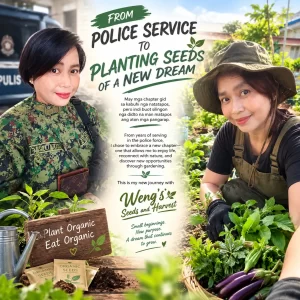
Lezo, Aklan- From serving the police force to growing chemical-free vegetables, Cherry Lee Sabino- Muñoz, retired PCMS turns retirement into an opportunity for healthier living, additional income, and environmental stewardship.
A retired Philippine National Police (PNP) personnel, Muñoz has found a new purpose after years of public service—not in another uniform, but in a garden where organic vegetables have become a source of food, income, and hope.
Through the Organic Agriculture Program (OAP) NC II of LEZO MPC in partnership with TESDA, Muñoz transformed her longtime interest in gardening into a practical livelihood, demonstrating how even a small growing space can produce meaningful results when combined with knowledge, patience, and determination.
In her commencement address on September 19, 2026, Muñoz shared how retirement became the beginning of a new chapter in her life. What started as an effort to provide free vegetables for her family’s daily meals eventually developed into an organic farming venture that also helped her save for personal goals.
“I may have changed my uniform, but my commitment to serve continues. I once served the people in police uniform; now, I serve in a different way through farming. The uniform has changed, but the heart to serve remains the same,” she told the Boracay Island News Network.
Before joining the program, Muñoz admitted that she used synthetic fertilizers in growing her vegetables because she had yet to learn safer alternatives. Her decision to enroll in the OAP NC II training was driven by her desire to understand organic farming methods and adopt more environmentally friendly practices.
During the training, she learned techniques in organic fertilization, concoction preparation, soil management, pest prevention, and maintaining ecological balance. More importantly, she gained a deeper appreciation of farming as a discipline that requires consistent care, observation, and patience.
After completing the program and earning her NC II qualification, Muñoz put her knowledge into practice by growing vegetables in different spaces around her home—including her backyard, rooftop, and roadside areas. She also used sacks as planting containers, proving that limited space need not prevent households from producing their own food.
Her efforts eventually attracted customers who wanted fresh vegetables grown using organic methods.
According to Muñoz, her vegetable sales generate around ₱100 or more on days when harvests are limited, and approximately ₱300 a day when produce is plentiful.
Although modest, the earnings have provided her with an additional source of income while helping reduce her family’s expenses for vegetables.
She saves part of the proceeds in an effort to achieve her future goals.
One of the most memorable milestones came in July 2026, when she traveled to South Korea using money saved from selling her vegetables—a personal achievement she attributed to the fruits of her gardening efforts.
For Muñoz, however, the benefits of organic farming extend beyond household savings and additional income. Her experience also encouraged her to reassess her diet and lifestyle following serious health concerns.
She disclosed that a 2024 PET-CT scan identified several medical conditions, including her previously diagnosed endometrial cancer, along with other reported findings involving her lungs, liver, heart, and blood sugar. These concerns prompted her to pursue what she called her “Operation: Healthy Lifestyle.”
She began eating vegetables daily, reducing her meat consumption, exercising through gardening, and maintaining a positive outlook while continuing her medical care.
In August 2026, she underwent another PET-CT scan and said the conditions noted in her earlier results were no longer seen in the new findings. She also reported that she remained cancer-free at the time of her speech, while continuing to recognize the importance of medical treatment, regular examinations, and doctors’ advice.
Muñoz emphasized that she does not attribute her medical improvements to organic farming alone. Instead, she pointed to a combination of medical supervision, healthier food choices, physical activity,
a positive outlook, and her faith in God.
Her story underscores how gardening can become part of a broader effort to improve one’s lifestyle while creating opportunities for household food production and supplemental income.
Addressing her fellow OAP NC II graduates, Muñoz encouraged them to apply what they learned instead of allowing their certificates to remain their only achievement.
She urged them to start wherever space is available—whether in pots, sacks, rooftops, balconies, or small backyard gardens—and gradually build their skills and experience.
“Plant organic, eat organic,” was among the principles she embraced as she pursued a healthier and more productive lifestyle.
From her years in the police service to her new role as an organic grower, Muñoz’s experience illustrates how retirement can open doors to new skills, practical livelihood opportunities, and meaningful contributions to the community.
Her journey carries a simple message: success does not always begin with a large farm or substantial capital. Sometimes, it begins with a small seed, a little space, and the determination to make something grow.
For Muñoz, organic farming has become more
than a hobby. It is a continuing mission to nourish her family, earn additional income, care for the environment, and inspire others to discover what they can achieve by starting small.
From planting seeds to nurturing dreams, Muñoz has shown that retirement can be the beginning of another fruitful journey.