Business
Aklan Piña industry thrives with government support, expands to ASEAN Market

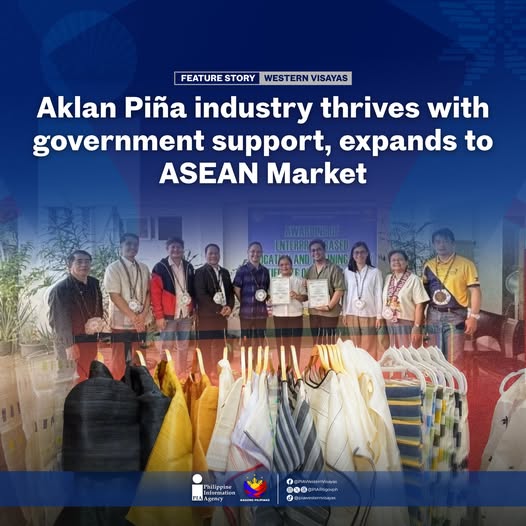
In the heart of Aklan province, the piña industry does more than preserve heritage; it sustains families, creates jobs, and strengthens local economies. Behind many of its threads of success is a key partner: the government, which continues to open doors not only locally but also across the ASEAN region.
For 21-year-old Aljean Fernandez of Tigayon, Kalibo, piña weaving is a generational craft. Her family’s business, Aklan Piña Cloth Industry, carries the brand Ceda Primera and produces barongs, gowns, shawls, short-sleeved pieces, polo jackets, and other piña-based apparel. While the enterprise was officially registered in 1998, its roots trace back to 1994 when her mother began working with piña, continuing a tradition passed down from Aljean’s grandmother.
“This is our main source of income. It is what we live on. It is also how we provide livelihoods for our employees. They depend on it, so the impact isn’t just on us, but also on our weavers, scrapers, and everyone involved,” Aljean said.
A key factor in the business’ growth has been the support from the Philippine Fiber Industry Development Authority (PhilFIDA), which helped establish their piña farm in Malinao. This allowed the family to produce their own raw materials, reducing costs and stabilizing their supply chain.
“As artisans, we cannot do this alone. With the help of the government and its programs, our financial burden has been eased through subsidies for some of our expenses,” she added.
A similar story is found in Balete, where 55-year-old Raquel Elicerio runs Raquel Piña Cloth Product, established in 2002. Producing everything from Filipiniana attire to barongs and gowns, her enterprise has grown into multiple weaving centers, helping send her children to school while expanding livelihood opportunities in the community.
Raquel credits a network of government support for much of that growth. A piña farm initiative, backed by the fiber industry and supported by policymakers such as Sen. Loren Legarda, strengthened her supply chain.
Additionally, the Department of Trade and Industry (DTI) and the Technical Education and Skills Development Authority (TESDA) provided training that upskilled workers in everything from fiber extraction to finishing.
Through DTI-Aklan’s continued efforts, the province’s piña products are steadily penetrating the ASEAN market. This is achieved first through participation in trade fairs at the provincial, regional, and national levels, where institutional buyers are invited, and international buyers are given access to Aklan’s world-class textiles.
According to Amiel Sumait, Senior Trade Industry Development Specialist of DTI-Aklan, these initiatives form part of a broader strategy to elevate piña beyond local appreciation and into the global arena. He emphasized that Aklan piña fiber has been awarded a Geographical Indication (GI), affirming its unique origin and quality, while piña weaving has also gained international recognition through its inscription under the UNESCO Intangible Cultural Heritage of Humanity list.
“These recognitions affirm the cultural and economic value of our piña industry and strengthen its position in both [the] ASEAN and [the] global markets,” Amiel said, adding that Aklan has existing exports to ASEAN neighbor Singapore as well as Japan, Paris, and the United States.
He noted that DTI’s focus now is international exposure, and one way of it is through its participation in Manila FAME, the country’s premier international trade fair, in partnership with LGU Kalibo and the Habol Piña Council. The event is expected to attract international buyers, designers, and partners who value the fabric’s unique production, intricate designs, and premium quality, while buying missions bring in institutional buyers who purchase in bulk, often clearing stocks, thereby strengthening Aklan piña’s position in ASEAN and global markets.
“Through the government, everyone gets connected—from the farmers at the grassroots level all the way to the market. It brings people together, much like this trade fair,” Raquel said.
Across Aklan, government interventions continue to address the piña industry’s most pressing challenges: long production cycles and high upfront costs. Piña fabric production remains highly labor-intensive.
As Aljean explained, “Each product passes through many hands before it becomes a source of income.”
Programs from PhilFIDA support raw material production, TESDA builds technical capacity, and DTI-led trade fairs open doors to buyers both locally and internationally. Together, these initiatives create a value chain where public support reinforces private craftsmanship while expanding market reach across ASEAN.
Raquel Piña Cloth Product now supports approximately 300 weavers, scrapers, and staff across Aklan.
“The job lets me connect with people, especially designers,” said Karen Mae D. Lucino, who handles bookkeeping, online marketing, and customer inquiries for the Balete-based enterprise.
Meanwhile, Ceda Primera employs around 70 workers, helping them build skills, confidence, and a deeper understanding of the craft.
“Working here taught me discipline, from managing daily operations to dealing with weavers and clients, and gave me a deeper understanding of how the business works from start to finish,” Aljean noted.
Both entrepreneurs emphasized that success in the industry requires patience, skill, and perseverance.
“You need patience and compassion in this business because it isn’t easy money,” Aljean said.
Raquel added, “Owners should know how to run their business from start to finish, from production all the way to marketing.”
With agencies like PhilFIDA, DTI, TESDA, and local government units weaving support into every stage—from farm to fiber, and fabric to market—Aklan’s piña industry demonstrates how tradition and progress can be tightly interlaced, now reaching beyond borders into the ASEAN and global marketplace. (AGP/SQP/PIA Aklan with reports from John Kenneth Adrimesin/DOLE-GIP)