Commentary
Boracay Cannot Wait A Bridge or Roro Facility For A Modern Food Supply Chain

World-Class Tourism Deserves World-Class Logistics
By John dela Cruz
Boracay welcomes approximately two million tourists annually, generating billions of pesos in economic activity. Yet behind its world-famous beaches and luxury resorts lies a fundamental weakness: an outdated logistics system that threatens food safety, affordability, and sustainable tourism growth.
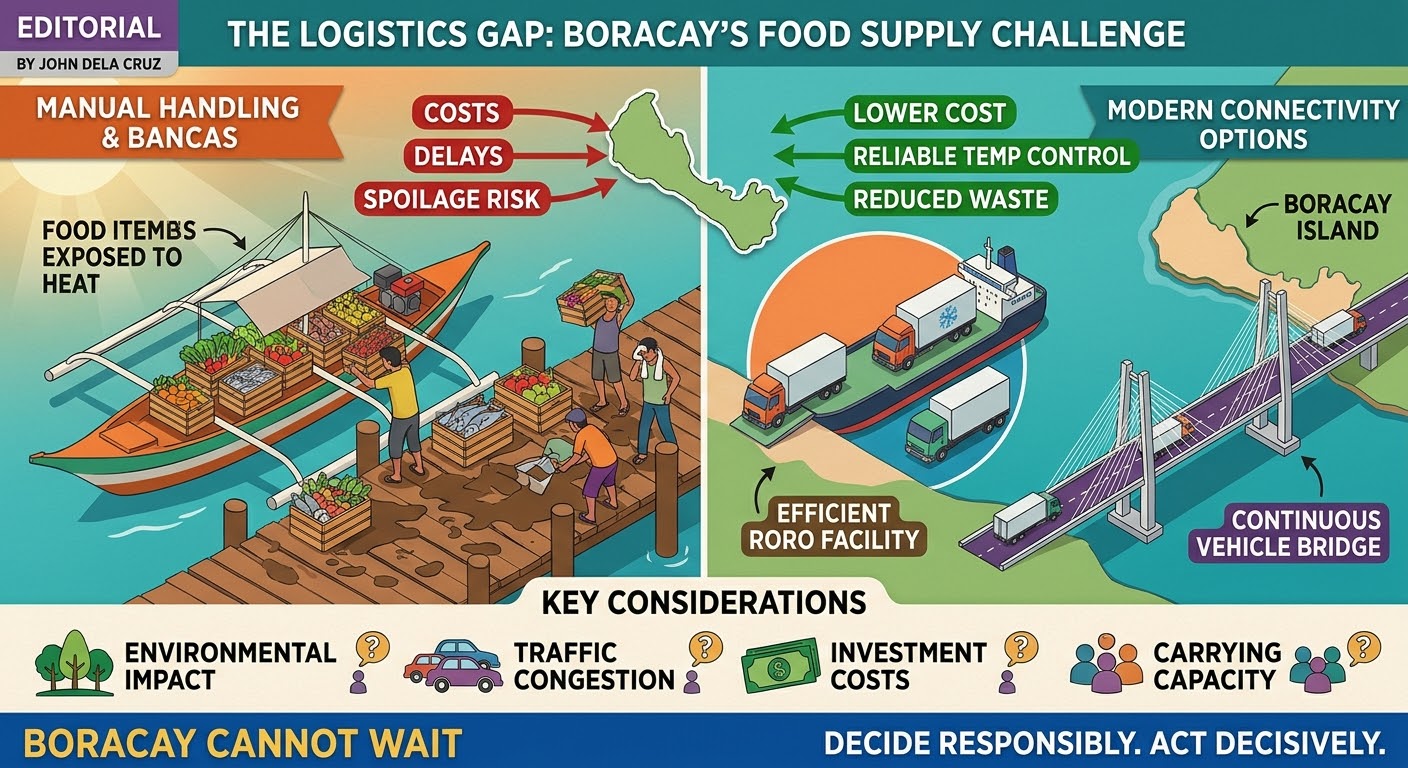
Every day, meat, seafood, vegetables, fruits, dairy products, and other essential goods must cross the narrow channel separating Boracay from mainland Panay.
Despite a crossing of roughly two kilometers, much of this cargo still depends on motorized bancas and manual loading and unloading at the ports.
Imagine refrigerated food products transported from Iloilo or Kalibo, only to be unloaded from trucks, exposed to tropical heat, carried onto boats, and handled again upon arrival.
Every transfer adds cost, delays delivery, compromises temperature control, and increases the risk of spoilage.
Who ultimately pays for these inefficiencies? Tourists, residents, hotels, restaurants, and ordinary consumers.
The question confronting policymakers is increasingly urgent: Should Boracay be connected through a bridge or served by a modern roll-on/roll-off (RORO) cargo facility?
A bridge could provide continuous vehicle access, while a dedicated RORO facility could transport refrigerated trucks directly across the channel without repeated cargo handling.
Both alternatives require careful evaluation of environmental impacts, traffic congestion, investment costs, and Boracay’s carrying capacity.
But one thing is clear: maintaining an inefficient food distribution system is not a sustainable long-term strategy.
A modern cold chain, supported by refrigerated storage, reliable transport, and efficient port infrastructure, is essential to keeping food safe and prices competitive.
As Boracay prepares for further tourism growth, infrastructure must advance alongside hotel development and visitor arrivals.
Government and private investors must establish a clear development timetable, backed by feasibility studies and decisive implementation.
The challenge is no longer simply how to attract more tourists, but how to serve them efficiently and affordably.
Across a channel barely two kilometers wide lies a critical infrastructure decision affecting Boracay’s future.
Build the bridge or modernize the crossing with RORO facilities. Study both, decide responsibly, and act decisively.
Waiting is not an option.