Commentary
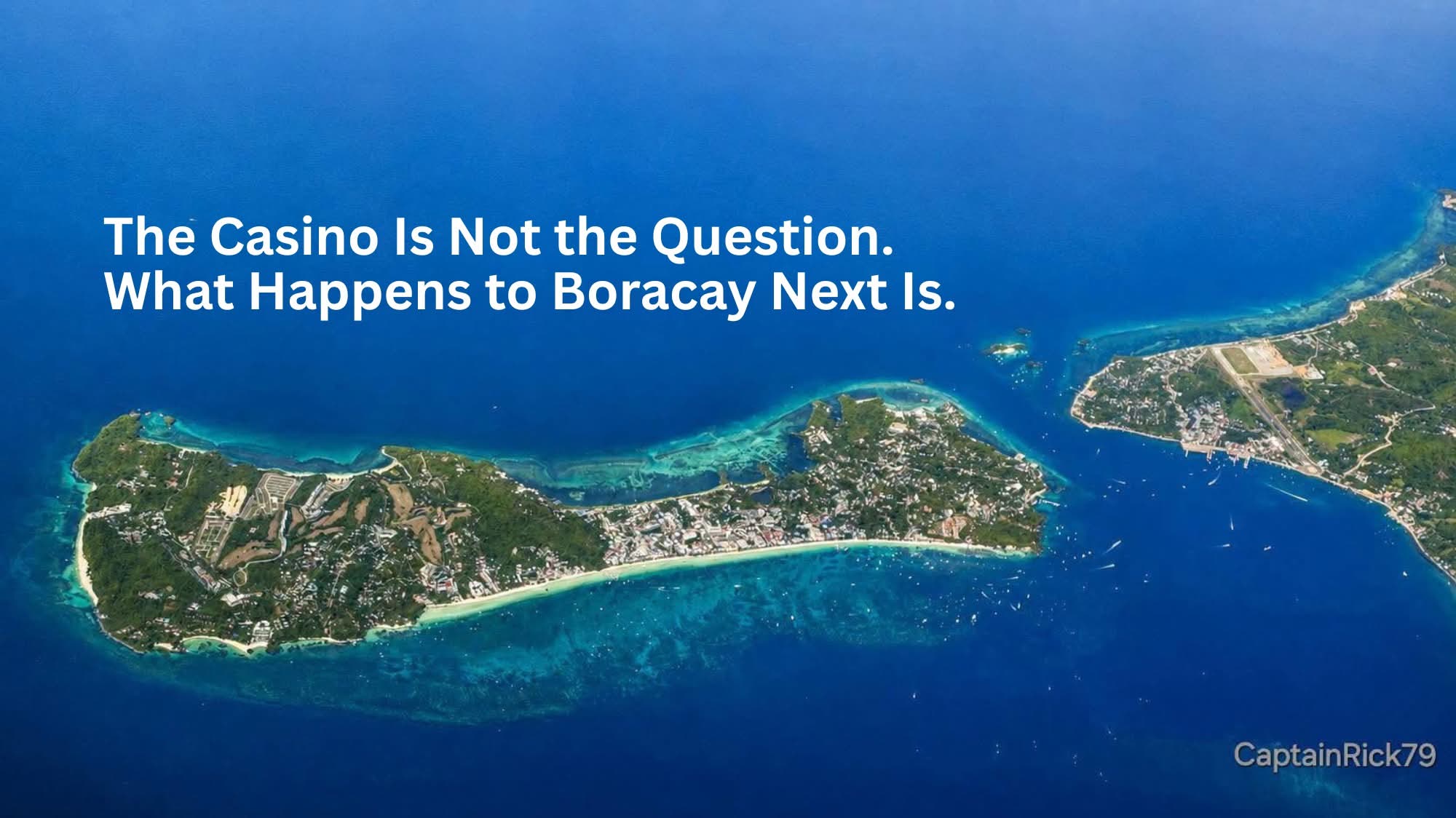
The Casino is not the Question

By: Chris Daday Cahilig
The opening of a casino in Boracay is not simply the arrival of another tourism establishment. It is a decision about the direction of the island.
The conversation about having casinos in Boracay is not new. In 2017, the Sangguniang Bayan of Malay approved Resolution No. 0068, declaring a 15-year moratorium intended to regulate the proliferation of casinos, gaming junkets, legal gambling activities and other PAGCOR- or GAB-sanctioned gaming operations in the municipality.
In 2018, Boracay got rehabilitated due to environmental concerns that resulted from uncontrolled development for years. Then-President Rodrigo Duterte even released a statement vowing not to allow casinos in Boracay, highlighting the need to be consistent with the rehabilitation goals.
In 2021, however, PAGCOR lifted its own three-year moratorium, creating a conflict, or at minimum a complicated relationship, between national policy and the local resolution, and the then-President changed his stance, saying we need casinos to augment funds for the government’s COVID-19 response.
Boracay community spoke up. Boracay Foundation represented by then-chairman Dionisio Salme issued a statement against casinos on the island. The Diocese of Kalibo also supported the stance. Several community leaders including the late SB Neneth Graf who is a respected environmentalist and Cris Cahilig of NABBSI articulated in separate interviews why casinos are incompatible with the Boracay Island being ecogically critical.
Even the Senate thru then-Senator De Lima filed of Proposed Resolution No. 907, which called for an inquiry into the lifting of the casino moratorium, specifically seeking to balance the economic needs of government with environmental protection and conservation of Boracay as an internationally recognized tourism destination.
Then the LGU-Malay’s casino moratorium got lifted and the massive construction in Yapak began. Nobody know exactly how it happened. Sure, the SB Resolution No. 68 had a caveat: it contained a mechanism for periodic review by the Sangguniang Bayan to determine the feasibility or viability of gaming activities and their economic impact on Malay. It seemed like it got reevaluated based on this premise. But this raises more follow-up questions. Because if a local government adopted a long-term policy (15-year) based on the island’s circumstances, what process should be followed before that policy is changed? Was there a comprehensive review? Was the carrying capacity reassessed? Were residents consulted? Were tourism stakeholders consulted? Were environmental and social impacts studied? Were the findings made public? And most importantly: did the community participate meaningfully in the decision? These questions are more important than whether someone personally likes or dislikes casinos.
‼️ Boracay’s carrying capacity and 23-hectare hotel-casino complex.
The 2018 rehabilitation didn’t happen because Boracay had too many businesses. It was undertaken because the island’s growth had outpaced its infrastructure and regulatory capacity. Wastewater had become a problem. Solid waste had become a problem. Illegal structures had become a problem. Traffic and congestion were problems. The island’s water and power requirements were increasing. The number of workers required to service the tourism economy was increasing. Housing became an issue. All of these problems were interconnected.
The rehabilitation therefore introduced a fundamental idea: Boracay has ecological limits. There is a carrying capacity, not only in terms of the number of tourists who can physically stand on a beach, but in terms of water, electricity, wastewater treatment, solid waste management, transportation, housing, emergency services, public safety and the ability of government to regulate development.
That is why the casino question cannot be isolated from the carrying-capacity question. A casino does not exist in a vacuum. It requires employees and their housing, water and electricity. It is important to note that the Visayas grid is not stable at this point. Rotational power interruptions are being done. The casino also produces wastewater and solid waste which requires transportation to the Sanitary Landfill in mainland Malay. That landfill is also in the verge of collapse from waste overload. Nearby communities are suffering from poor air quality to polluted streams. Development this big generates additional demand for accommodation, restaurants, entertainment and other services, which attracts more visitors. And this massive complex also encourages additional high-end commercial development around it. Then the impact is potentially much larger than the physical footprint of the casino itself.
‼️ There is also another layer: the social impact.
Gambling introduces another category of concern that ordinary hotels and restaurants do not necessarily bring. These include gambling addiction, financial harm, underage access, crime, money laundering risks and other social consequences associated with gaming. Those concerns should neither be exaggerated nor dismissed. A regulated casino is different from illegal gambling. There are also responsible-gaming rules and regulatory controls. But regulation does not eliminate the need for monitoring. If gambling becomes part of Boracay’s tourism economy, the island should also be able to discuss the social safeguards accompanying it. How will gambling problem be addressed? How will illegal lending or other associated activities be prevented? How will law enforcement respond if gambling-related crime increases? How will the municipality measure these impacts? Is the municipality even ready for these additional responsibilities? Again, the point is not to assume that these problems will happen. The point is to make sure that the policy framework exists before they become problems. This is why the comprehensive assessment of its economic potential should be accompanied by a thorough review of its potential negative impact as well.
‼️ Impact on forest cover and biodiversity due to the presence of flying foxes roosting sites
It is important to note that this 23-hectare development sits right in heart of a declared forestland area per Presidential Proclamation No. 1064 which was signed in 2006 by then-President Gloria Arroyo. This supersedes her previous proclamation no. 803 which she signed in 2005, declaring the area part of the tourism economic zone. Although the area is allegedly a titled property, the proposed critical habitat for the flying foxes falls right in the property which was identified under the Boracay Action Plan during the rehabilitation in 2018. The presence of the flying foxes in the area was well documented since 2007 by the Friends of the Flying Foxes, a conservation NGO based in Boracay island.
Aside from this conflicting land use issue, the area is one of the few lush green covers left in Boracay. NABBSI, an NGO for land rights based in the island as well, has an active administrative dialogue about this matter with DENR Central. They questioned why does this development went through without the Forest Land-Use Plan (FLUP) which is a fundamental requirement for any development to proceed within a declared forestland. Without this plan, no development or occupation should be permitted because land ownership and right to develop are separate concerns, especially in ecologically significant area like Boracay. Landowners still need to follow Land-Use management regulations and since there is none yet, the development should not even start. The organization further underscores that the prosecution of long-time forestland occupants in other forestland blocks in the island is carried out by the DENR while this development is permitted when there is still no FLUP for the entire Boracay Island.
This is where everything culminated, the disturbing reality on the ground. The moratorium was lifted, the development went ahead without FLUP, seemingly paving the way for this casino complex to operate. Is this 23-hectare property worth wiping out our remaining forest cover and destroying our threatened biodiversity?
The main problem is not the mere opening of one casino. It is the fact that this one creates a precedent. And a responsible government should have undergone a comprehensive social impact assessment on top of environmental and economic considerations before lifting that moratorium. Did they think what is next for Boracay when casino mega complexes sprout like mushrooms since they allowed one already?
No doubt that casinos bring additional income for the economy. But are we ready for its consequences? LGU-Malay currently still struggles to manage solid waste problems as well as wastewater including sewage, among others. The capacity of facilities is still not enough to cover the whole island. Drainage networks are still not fully operational. How much more when casino visitors and their impact overload the already collapsing system?
These are not simple problems to solve but it can exponentially snowball into something that another rehabilitation might not be enough anymore. It is the same conundrum with the proposed Boracay Bridge. Is the needed infrastructure for the island in place already so developments like this can be justified? Or an even more important question is, do we really need this kind of development for the long-term resiliency of the island?
Boracay is an ecologically critical tourist destination. What lies ahead for Boracay should have been clear by now after the lessons of rehabilitation. But it seems that we still have not learned anything yet.
Ensuring Boracay’s long-term resilience should, by now, be a shared responsibility.
Corporations will naturally pursue profitable opportunities. Government agencies will operate within the priorities and directives of their respective leadership. Fragmentation in governance, particularly in a destination where national and local mandates overlap, may be inevitable.
But stakeholders are different. It is the people who live here, work here, invest here, depend on Boracay’s tourism economy, and benefit from the ecological services that the island provides who have the greatest stake in ensuring that its limits are respected. They should be among the first to ask whether the necessary safeguards are in place before accepting another major activity or development into the island.
And yet, as I watched this particular issue unfold, I could not help but feel that this collective voice was not as visible or as strong as it should have been. Perhaps that is the most disappointing part of all.
Boracay’s future cannot be secured by the government alone, nor can it be entrusted solely to those who see the island as an investment opportunity. Ultimately, its long-term resilience will depend on whether those who live here and benefit from it are willing to stand up for it.
Looks like we failed on this one. What moral authority do we have to demand environmental responsibility and sustainable tourism from others when we, as stakeholders, are inconsistent in defending the very principles we claim to stand for?
#hardquestions #uncomfortabletruths #boracayprotectionNOTprofit
Photo credit: CaptainRick79