Environment
Time to Shift Gears: Indonesia’s Second NDC Should Prioritize Organic Waste Reduction, Not Incineration

Bandung— Composting organic waste and implementing decentralized zero waste strategies could enable Indonesia to meet its climate targets in the municipal solid waste sector while addressing its escalating landfill crisis. A new assessment by Global Alliance for Incinerator Alternatives (GAIA) finds that focusing on source separation, separate waste collection and decentralized organic waste treatment—such as composting, biodigesters, and Black Soldier Fly (BSF) farming—offers the most effective, inclusive, and climate-smart approach to reduce methane emissions, the dominant climate pollutant from Indonesia’s waste sector.
Dwi Sawung, Spatial and Infrastructure Campaign Manager of WALHI comments, “Putting communities and climate at the heart of Indonesia’s climate ambition is a must, particularly with the Indonesia government’s latest plan to close 343 open dumping sites, or simply dumpsites, nationwide. We must ensure that this critical action is paired with a genuine just transition—one that protects the livelihoods of over 600,000 waste pickers and informal workers and equips them for new opportunities in decentralized organic waste treatment.”
He adds, “By embedding meaningful consultation, targeted support programs, and dedicated financing for community‑ and waste‑picker‑led composting, biodigestion, and black soldier fly initiatives into the closure plan, put them as part of new waste management system, we can close dumpsites without leaving anyone behind—and chart a truly inclusive path to a zero‑waste, zero‑emission future.”
Indonesia generates over 32 million tonnes of waste annually, with more than 50% made up of organic materials like food and garden waste. Methane from this unmanaged organic waste accounts for 56% of Indonesia’s total methane emissions, making waste the country’s largest methane-emitting sector. Yet, Indonesia’s current climate strategy leans heavily on costly, polluting end-of-pipe technologies such as Waste-to-Energy (WTE) incineration and Refuse-Derived Fuel (RDF), which are poorly suited to Indonesia’s wet waste and risk shifting methane to long-lived CO₂ emissions. These solutions have also triggered public backlash and project failures across the country, including at the Rorotan and Jimbaran RDF facilities.
“Separate waste collection and decentralized organic treatment have proven to be sustainable and resilient strategies in Bandung,” said David Sutasurya, Director of YPBB Bandung. “These decentralized strategies not only cut emissions, but also create green jobs, strengthen the local economy, and support waste workers and small businesses. They even contribute to food security by producing healthy compost that supports local agriculture—improving the citizens quality of life.”
David Sutasurya also highlights that “Even during the waste emergency, districts practicing zero waste were largely unaffected by landfill closures or fires, and continued reducing methane emissions through community-led systems.”
City-level experiences in Bandung, Cimahi, Karawang, Purwakarta, Sumedang, Gianyar, Solo, and Gresik show that this approach is not only technically viable but also resilient—districts implementing zero waste strategies remained operational during recent landfill closures.
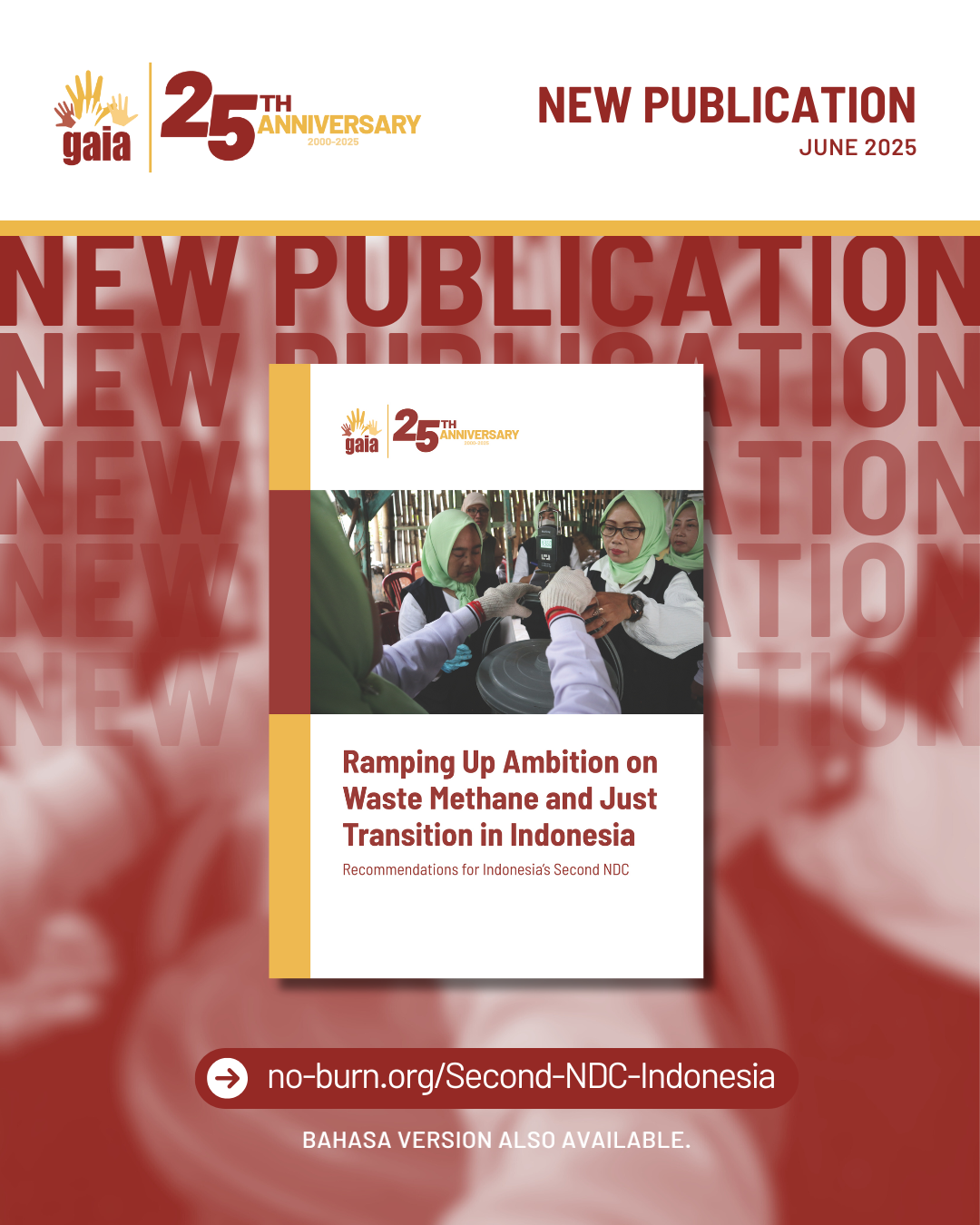
The report, Ramping Up Ambitions on Waste Methane and Just Transition in Indonesia, urges Indonesia to update its Second Nationally Determined Contribution with stronger targets and clear, upstream measures that prioritize source-separated collection, decentralized organics processing, and the inclusion of informal waste workers.
Yobel Novian Putra, Global Climate Policy Officer of GAIA stresses, “Indonesia’s Second NDC represents a pivotal moment to shift away from emission‑intensive, highly expensive, downstream-focused technologies —particularly WtE incineration, RDFs and landfill gas capture— that only switches methane emissions to carbon dioxide, undermining long-term climate goals. Instead, the Government of Indonesia should harness the untapped potential of food loss and waste prevention and organic waste treatment.”
He continues on saying that, “By prioritizing solutions that follow the waste hierarchy, Indonesia can cut landfill methane by over 90%. Such strong ambitions in the Second NDC can unlock vital international and domestic finance to drive implementation and curb waste methane fast, most especially for local governments, community groups and waste pickers who are at the forefront of implementation but also most affected by the recent nation-wide plan of dumpsite closures.”
Importantly, the report reveals that these climate-aligned actions could unlock international climate finance. Global frameworks such as the Global Methane Pledge, Reducing Organic Waste (ROW) Declaration, and the Lowering Organic Waste Methane (LOW-M) Partnership highlight the growing momentum and funding opportunities available for methane reduction strategies rooted in environmental justice. However, Indonesia’s current unconditional (CM1) and conditional (CM2) NDC targets fall short of ambition—missing a key opportunity to scale up proven, community-led organics management.
As Indonesia prepares to submit its updated Second NDC at COP30, the message is clear: addressing the country’s largest methane source—organic waste—through inclusive, simple yet effective solutions will not only fulfill climate commitments but also support a just transition and unlock critical climate finance. This is a once-in-a-decade chance for Indonesia to lead by example and become a climate champion in the waste sector.