Agriculture
Young rice farmer in Bukidnon harnesses drone tech, hopes to bolster rice productivity

By: Vic Thor Pallarca
Quezon Bukidnon- Considered as the Rice Granary of Quezon, Bukidnon, Barangay Paitan is home to a young rice farmer who is committed to using and implementing agricultural innovations and technologies to contribute to the country’s goal of food security and sufficiency. At 21 years old, Peter Emmanuel Balmores Berong of Balmores Diversified Integrated Farm is introducing a modern approach to rice farming in his community by embracing cutting-edge drone technology.
“I grew up immersed in our family farm from an early age. Before we adopted new technologies, my daily activities included land preparation, sowing the fields, and helping my grandparents feed the goats and chickens. Now that we have embraced new techniques and technologies, my role has evolved. I now operate the drone, make organic fertilizer concoctions, and apply agricultural solutions across the farm. I also designed the farm layout and am currently overseeing the ongoing construction of a new project building, all while actively serving as the SK (Sangguniang Kabataan) chairman. Despite my hectic schedule, I am driven by a deep passion for farming and am working to manage everything efficiently. Peter said, sharing his daily activities on their farm.
As a third-generation farmer from Paitan, Quezon, Bukidnon, Peter has seen firsthand the challenges that traditional farming methods can pose, from labor-intensive tasks to inefficient resource management. But all that changed when Peter participated in the Training of Trainers (TOT) Farmers Field School (FFS) Production of High-quality Inbreed Seed, Seed Certification, and Farm Mechanization organized by the Agricultural Training Institute–Regional Training Center X (ATI-RTC X).
Nowadays, farmers are increasingly turning to drone technology to optimize their agricultural operations. It is also timely that Peter was already introduced to the transformative potential of drone technology in rice production, as their family offers services for fast and efficient seed spreading and spraying of insecticide and herbicide through DJI Agricultural Drone using AGRAS T30. A drone model with an operating tank of 30 liters. It can also cover 25 hectares of rice fields for insecticide and herbicide applications.
“The drones are a huge help for farmers like us because we can save on seedlings and labor costs. Hopefully, the technology is accessible and affordable enough to encourage farmers in our community to utilize it since it can be used for a variety of tasks, including land imaging, surveying, soil monitoring, irrigation monitoring, and targeted spraying. As of the moment, we are trying to convince nga mag-adapt ang mga farmers sa atong mga bag-o nga technologies. So far, sa mga close friends and family namo nga ga-gamit or ga-adapt sa atong agricultural drone, positive kaayo ang feedback.” Peter said in the vernacular.
Peter is a licensed drone user and now regularly performs a variety of tasks using drone tech on their family farm from precision seeding and fertilizer application to crop health monitoring and pest management. He takes full advantage of their drone tech, with the supervision of his farmer parents Peter and Sonia Balmores Berong.
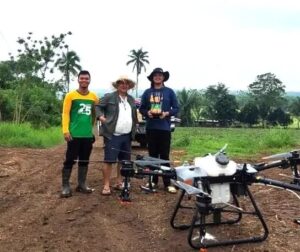
“When it comes to using an agricultural drone for spray and spread of farm solutions and fertilizers, every application is calculated. For example, for herbicide application, if we have 1 liter of herbicide and we need to apply it in a 1-hectare field area, rest assured that the 1-liter herbicide is precisely applied on the 1-hectare field area. The application is precise and efficient because we don’t need to step into the rice field to do the manual spraying. It is also not time-consuming if we apply insecticide since it can be done in seven minutes of flight time. Also, landowners have less maintenance in a big area since the planting, or the harvesting can be done simultaneously, all they must do is have proper irrigation and clean the rice paddies.” Peter stated further.
As the country grapples with the challenges of feeding a growing population and adapting to the impacts of climate change, Peter’s story serves as a shining example of how innovation and technology can help revolutionize the rice industry.
“As a young farmer, I would use my youth to engage more often with our farmers, I would use the knowledge from the trainings I have attended to convince farmers to be adaptive to the changing times. I will also encourage or challenge them to use less input but generate more income. I am now 21 years old, and we are planning to have rice-based products soon like rice coffee, rice barquillos, and much more”, Peter shared.
A year later of co-managing and drone operating their farm (and other farms), Peter, in a Facebook messenger exchange shared an update about his farming exploits.
“So far, okay kaayo ang experience karon kay dako gyud og natabang ang teknolohiya sa mga farmers Ako gyud ni gi-gahinan ug time nga dako dako ang pagka-drone pilot. Dili lang kay ako lang karon ang ga-pilot pero isa ko sa upat namo ka pilot, ako sad mismo ang ga-operate sa drone for spraying ug seed broadcasting mainly sa rice. Just recently, nagdungag mi og bag-ong drone, mas high-capacity siya. Kaya na niya i-spray up to 50 hectares per day, compared sa una nga mga 15-20 hectares lang per day. Mas maka-save jud mi ug time sa trabaho. Dili na pud kaayo mi exposed sa chemical kay ang drone na ang ga-spray.
Ako gyud maingon, especially sa mga farmers nga baguhan or wala pa naka try ug pa-spray or broadcast gamit ang drone, ayaw kahadlok ug adapt sa mga new technologies, labi na sa farming. Sa una, manual tanan, magsabod ug abuno, mag-spray gamit knapsack. Kapoy, dugay, usahay sayop pa ug apply. Pero karon, with GPS-guided drones, accurate na ang pag-spray, maka-save pa sa tubig ug pesticide. Mas healthy pud ang tanom kay equal ang distribution.
Ang resulta pud based sa mga farmers nga among na serbisyohan, mas taas ang yield, mas paspas ang trabaho, ug mas dako og kita. Maka-focus na pud sila sa laing importanteng butang sa uma like soil health, water management, etc. Kay maka-save naman ug time si farmer sa pag-spray, sauna nga 2-3 hours mag spray sa 1 hectare, karon 15 mins nalang apil na diha pag charge ug pag tubil sa chemicals sa drone.
Plano namo mag-expand pa gyud gusto namo mag-provide ug drone services sa ubang farmers, dili lang sa among lugar, kung dili sa tanan nga gusto magpa-serbisyo. Gina aim pud namo nga dili lang kami ang maka-experience ani nga innovation. Ang modern farming dili angay nato nga balewala-on kay naa sa atong mindset nga mahal, dili ka afford or unsa pa na, pwede kaayo ni sa mga ordinaryong mag-uuma basta willing mo learn ug mo adapt.
Para nako, farming is not just trabaho lang, it’s a passion. And with the help of technology, mahimo gyud siyang sustainable ug profitable” said Peter in Cebuano language.
(Translation: So far, the experience has been very good because technology really helps the farmers a lot. I have really dedicated a lot of time to being a drone pilot. It’s not just me piloting now, but I am one of the four pilots we have on the farm. I am also the one operating the drone for spraying and seed broadcasting, mainly for rice. Just recently, we added a new drone with higher capacity. It can spray up to 50 hectares per day, compared to before when it was only 15-20 hectares per day. We really save time on work. We are also less exposed to chemicals because the drone does the spraying.
I can also say, especially to new farmers or those who haven’t tried spraying or broadcasting using drones yet, don’t be afraid to adapt to new technologies, especially in farming. Before, everything was manual — spreading fertilizer, spraying using knapsack sprayers. It was tiring, slow, and sometimes incorrectly applied. But now, with GPS-guided drones, spraying is accurate, and it saves water and pesticides. The plants are healthier too because the distribution is equal.
The results based on the farmers we have served show higher yields, faster work, and bigger income. They can also focus on other important farm tasks like soil health, water management, and so on. Because the farmer saves time spraying, what used to take 2-3 hours to spray 1 hectare now only takes 15 minutes, including charging and refilling the drone with chemicals.
We plan to expand and want to provide drone services to other farmers, not just in our area but to everyone who wants to avail of the service. We also aim for more people to experience this innovation. Modern farming shouldn’t be ignored because of the mindset that it’s expensive or unaffordable or for other reasons. This is really accessible to ordinary farmers as long as they are willing to learn and adapt. For me, farming is not just a job, it’s a passion. And with the help of technology, it can really become sustainable and profitable.)
For Peter, the future of rice farming in Quezon, Bukidnon is bright, and he is determined to be at the forefront of this digital transformation. “I want to inspire young people to put much weight in farming so that someday, all the silent heroes—our farmers, will stand with their heads held high, prosperous, dignified, and proud”, Peter concluded.
To avail of DJI Agricultural Drone services, feel free to get in touch with Peter at this number: 0992-800-3032 or visit Balmores Diversified Integrated Farm.
This is an updated article, the original article was first posted here: https://ati2.da.gov.ph/ati-10/content/features/young-rice-farmer-quezon-bukidnon-harnesses-drone-tech-hopes-bolster-rice-productivity