Commentary
The Search for Calivo Meteorite

By: Ro Akeanon
A Lost Scientific Treasure of Kalibo, Aklan
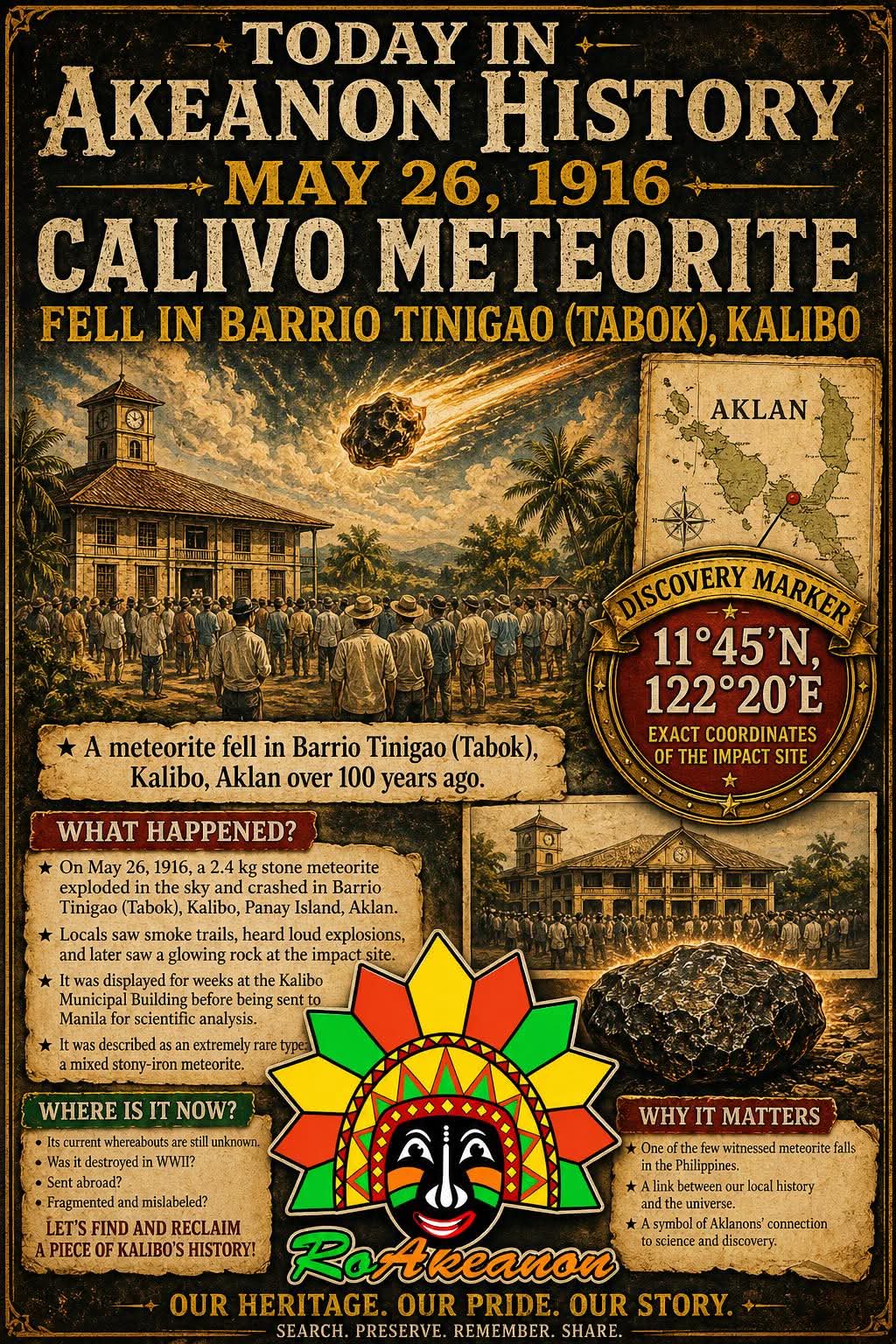
KASAYOD KAMO? Over a century ago, something extraordinary fell from the skies of Aklan—witnessed by many, studied by scientists, and remembered in fragments of history.
This is the story of the Calivo Meteorite—and the search for where it is today.
⸻
📍 A Fire from the Sky — May 26, 1916
On the afternoon of May 26, 1916, the calm skies over Kalibo were suddenly shattered by a series of loud, explosive sounds.
Across nearby towns—Numancia, Makato, and New Washington—people heard:
* Thunder-like detonations
* A whizzing, rushing sound in the air
* Smoke trails streaking across the sky
Moments later, a strange object fell in Barrio Tinigao (Tabok) now Barangay Mobo near the home of the Villanueva family.
It struck the earth with force—
breaking vegetation, embedding itself into the ground, and leaving the community in shock.
Some believed it was:
* A cannonball from a warship
* A falling machine part
* Or even a sign of the end of the world
But it was something far rarer.
⸻
🏛️ From Sky to Town Hall: Kalibo’s Meteorite Moment
After its recovery, the object—weighing about 2.4 kilograms—was brought to the town proper of Kalibo.
There, it was publicly displayed at the municipal building, where it quickly became the center of attention.
For weeks:
* Crowds gathered daily to see the “stone from the sky”
* People traveled from across Aklan out of curiosity
* The event became one of the most talked-about phenomena in the region
Eyewitness accounts even noted that the stone appeared to glow at night, likely due to its fresh fusion crust reflecting light and its recently altered surface from atmospheric entry.
Recognizing its importance, the Municipal President (Mayor) Simeon Mobo Reyes,
took custody of the meteorite to ensure its safekeeping.
⸻
🔬 From Kalibo to Manila: Science Takes Over
As interest in the object grew, portions of the meteorite were sent to Manila for formal scientific study at the
Bureau of Science.
There, it underwent:
* Chemical analysis
* Petrographic examination
* Laboratory classification
Scientists confirmed that the object was indeed a meteorite—one of the very few recorded falls in the Philippines.
⸻
🧪 A Rare Visitor from Space
Analysis revealed that the Calivo meteorite was not ordinary.
It contained:
* Iron and nickel (metallic components)
* Silicates (stony material)
* Strong magnetic properties
Its surface showed a fusion crust, formed as it burned through Earth’s atmosphere.
Rather than being purely metallic or purely stony, the meteorite appeared to be a mixed type, likely a rare stony-iron (siderolite).
This made it scientifically valuable—not only in the Philippines, but internationally.
⸻
🕳️ The Mystery: Where Is It Now?
After its study in the late 1920s, the trail of the Calivo meteorite fades.
There are no clear modern records showing:
* Where the main specimen is stored
* Whether it survived intact
* Or if fragments still exist
⸻
🔍 Theories Behind Its Disappearance
⚔️ Lost in War
The collections of the Bureau of Science were heavily damaged during World War II, especially in the destruction of Manila in 1945.
👉 The Calivo meteorite may have been destroyed during this period.
⸻
🌍 Sent Abroad
It is also possible that fragments were sent to foreign institutions such as the
Natural History Museum
However, no confirmed record has yet been found.
⸻
📦 Hidden or Misidentified
Some pieces may still exist:
* Stored under a different name
* Kept in archives
* Or held in private collections
⸻
🇵🇭 Aklan’s Forgotten Cosmic Heritage
The Calivo meteorite is more than a scientific object—it is part of Aklan’s identity:
* A witnessed event
* A shared community memory
* A connection between Kalibo and the universe
And yet today:
* There is no historical marker in Mobo
* No museum exhibit in Kalibo
* Little public awareness of its significance
⸻
🌟 The Search Continues
The story does not end in 1916—or in 1929.
It continues today.
Through research, storytelling, and community effort, the Calivo meteorite can be rediscovered—not only as a physical object, but as a living part of Aklan’s heritage.
⸻
📣 A Call to Action
To the people of Aklan, historians, and leaders:
Mark the place where it fell.
Preserve the story.
Search the archives.
Because somewhere—whether lost, hidden, or waiting to be rediscovered—
a piece of Kalibo’s sky still exists.