Lifestyle
Why is universal healthcare so elusive in the Philippines?

For many Filipinos, illness doesn’t begin with a diagnosis. It begins with a question: How much will this cost us?
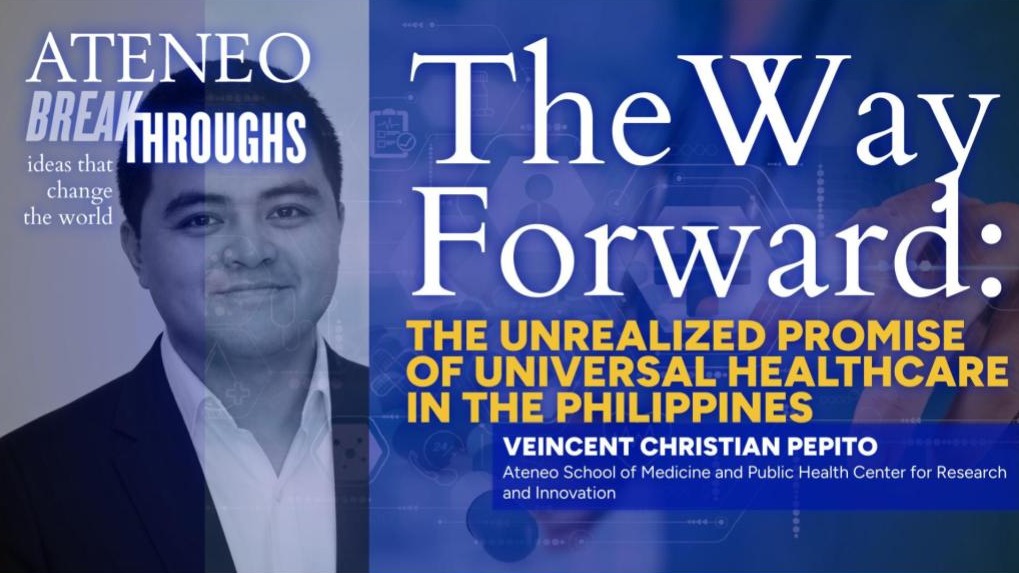
At the latest Ateneo Breakthroughs lecture, Veincent Christian F. Pepito—a public health researcher and assistant professor at the Ateneo School of Medicine and Public Health’s Center for Research Innovation—centered the discussion on this question, thereby shedding light on the roadblocks to universal healthcare in the country.
When the Universal Healthcare (UHC) Act lapsed into law in 2019, it carried a bold hope: that no Filipino would be left behind in the nation’s health system. Yet years later, that hope still feels distant for many. In hospital corridors, barangay health centers, and the quiet corners of countless homes, families still count the cost before seeing a doctor, make do with half-finished treatments, wait for hours, or go without care altogether.
View Pepito’s full lecture at ateneo.edu/breakthroughs
In his research and interviews, Pepito came across one respondent’s striking observation: healthcare is rarely a political priority. Roads, infrastructure, and flood control projects provide politicians with tangible, visible projects that resonate with the public and contribute to electoral success. Healthcare, however, doesn’t offer the same visibility; its impact is often unseen and fails to capture immediate popular attention in the way that politicians need to sway votes.
Through conversations with health workers, government officials, and patients across the country, Pepito’s research reveals a picture of a healthcare system pulled apart at the seams. Families and professionals alike feel the impact of a system split between national directives and local realities. Budgets fail to keep pace with rising costs. Health workers are unevenly distributed and often overburdened. The digital systems designed to help patients often fail to deliver effectively.
The result is a system that lives on paper but struggles in practice.
Pepito reminds us that universal healthcare isn’t just a matter of paperwork or policy. It is measured in the split second whether the system is there, ready and working, right when Filipinos need it most.
“A health system must be built, coordinated, financed, staffed, trusted, and made intelligible to the people it is meant to serve,” said Dr. Filomeno Aguilar, Assistant Vice President for Research, Creative Work, and Innovation, in his opening remarks, pointing out that good intentions alone cannot deliver equitable care.
Still, there are signs of progress. The lecture highlighted practical efforts: improving primary care, strengthening local health leadership, and building systems that allow patient records to move with the patient.
But as long as an illness forces Filipinos to compute, postpone, or compromise, universal healthcare remains a promise in progress.
Pepito made one thing clear: For millions of Filipinos, healthcare is not an abstract system; it’s a daily risk, a financial burden—and, far too often, an unanswered question.