Commentary
Legal Narratives of Boracay Island

By: Dr. Jimmy Maming
I watched a local interview last night and the assumptions of the interviewee was disturbing
and for me it was a Misinformation. Her contentions especially the concluding statements implied
that what happened to Boracay can be replicated anywhere in the Philippines, referring to the
Presidential Proclamation 1064 as the baseline framework. As a former Member of Media and
Information Literacy, I am compelled to do research hoping that this matter will be enlightened by
facts and not just mere speculations. I personally believe that the government conducts themselves
by rules and not a half hazard insight knowing that crafting a law is a process- a tedious process.
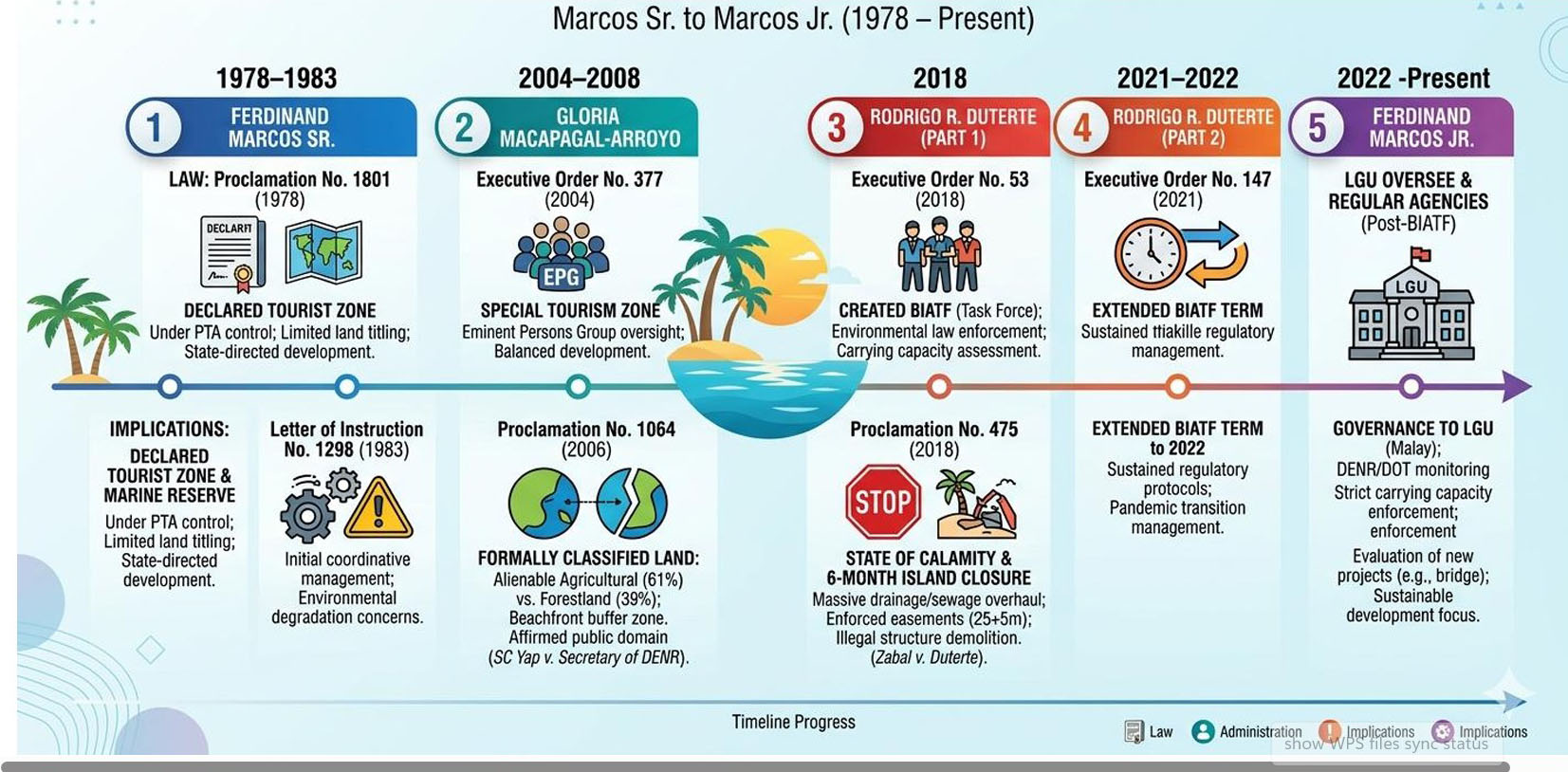
Here is a consolidated, chronological mapping of the key national laws, proclamations, and
executive orders governing Boracay Island from the administration of Ferdinand Marcos Sr. to the
present. This timeline highlights the legislative trajectory of the island, tracing its evolution from
an unclassified marine reserve to a heavily commercialized destination, and eventually to a strictly
regulated, rehabilitated ecological zone.
National Policy Framework for Boracay Island
The Law / Issuance
The President Implications for Boracay Island
Proclamation No. 1801
(November 10, 1978)
FerdinandvMarcos Sr.
Declared Boracay and its surrounding waters as a Tourist Zone and Marine Reserve. It placed the
island under the administration and control of the Philippine Tourism Authority (PTA). Crucially, this
limited land titling and spontaneous alienation of the public domain, establishing that development must strictly align with state-directed tourism.
Letter of Instructions
No. 1298 (1983)
Ferdinand Marcos Sr.
Created an early coordinative mechanism to manage development and stem environmental
degradation as the island began attracting international backpackers and tourists. It mandated basic
compliance with initial safety and planning guidelines.
Executive Order No.
377
(October 22, 2004)
Gloria Macapagal Arroyo
Proclaimed Boracay as a Special Tourism Zone and authorized an Eminent Persons Group (EPG) to
oversee its sustainable development. It aimed to balance massive commercial growth with the
preservation of cultural and natural resources across Barangays Yapak, Balabag, and Manoc-Manoc.
Proclamation No. 1064
(May 22, 2006)
Gloria Macapagal Arroyo
Formally classified the land of Boracay Island. It categorized 628.96 hectares (60.94%) as Agricultural
Land (Alienable and Disposable) and 377.68 hectares as Forestland (Protection Purposes). It also established a 15-meter buffer zone on both sides of road centerlines. This proclamation’s constitutionality was later upheld by the Supreme Court in Secretary of the DENR v. Yap (2008), solidifying the doctrine that Boracay’s unclassified land belonged to the public
domain.
Executive Order No. 706
(January 18, 2008)
Gloria Macapagal Arroyo
Mandated the Secretary of Tourism to directly exercise the administration and control functions of the
PTA over Boracay. This central governance structure attempted to coordinate local government unit (LGU) mandates with national environmental policies during a period of rapid commercial expansion.
Executive Order No. 53
(May 8, 2018)
Rodrigo R. Duterte
Created the Boracay Inter-Agency Task Force (BIATF). This body was empowered to enforce strict
compliance with national environmental laws (such as the Clean Water Act and Ecological Solid Waste
Management Act), reverse massive ecological degradation, conduct carrying capacity assessments,
and manage infrastructure rehabilitation.
Proclamation No. 475
Rodrigo R. Duterte
Declared a State of Calamity and ordered the total closure of Boracay to tourists for six months (April 26 to October 25, 2018). This unprecedented move (April 26, 2018) facilitated the literal overhaul of the island’s broken drainage and sewage systems, the enforcement of the 25+5 meter beachfront easement, and the demolition of illegal structures on wetlands and forestlands. The legal exercise of this police power was validated by the Supreme Court in Zabal v. Duterte (2019).
Executive Order No. 147
(September 14, 2021)
Rodrigo R. Duterte
Extended the term of the BIATF until June 30, 2022, ensuring that the critical regulatory, carrying-capacity enforcement, and infrastructure protocols initiated during the 2018 rehabilitation were sustained during the pandemic transition.
Current Administrative Supervision & Local Governance Acts
(2022–Present)
Ferdinand Marcos Jr.
Transition of oversight back to local government and regular line agencies. Following the expiration of
the BIATF mandate, governance reverted to the Municipality of Malay, Aklan LGU under strict DENR
and DOT monitoring. Contemporary governance focuses on enforcing the established carrying capacity,
evaluating large-scale infrastructure projects (such as the proposed Panay-Boracay bridge project), and
regulating high-value event tourism under sustainable frameworks.
A presidential proclamation cannot divest an individual of a vested right or a valid, preexisting Torrens title. Private property enjoys absolute protection under the Due Process Clause of the fundamental law, which mandates that no person shall be deprived of life, liberty, or property without due process of law [PHIL. CONST. art. III, section 1].
Under the land registration laws of the Philippines, a Torrens title issued pursuant to a valid judicial or administrative decree becomes indefeasible and incontrovertible upon the expiration of one year from its date of entry, serving as an absolute shield against subsequent collateral attacks or executive reclassifications [Presidential Decree No. 1529, section 32 (1978)].

(photo by: Joel Jaws Andrada)
The Evolution of Executive Frameworks on Boracay Island
The legislative history of Boracay demonstrates a clear shift from centralized preservation under the administration of Ferdinand Marcos Sr. [Proclamation No. 1801 (1978)], to managed development and land classification friction under Gloria Macapagal-Arroyo [Proclamation No. 1064 (2006)], and finally to aggressive state police power and ecological rehabilitation under Rodrigo Duterte [Proclamation No. 475 (2018); Exec. Order No. 53 (2018)]. The primary legal tension throughout this timeline remains the structural conflict between national environmental/public domain laws and local zoning or commercial land claims.
The Statutory Status Prior to 2006. Prior to 2006, Boracay Island was legally unclassified public land. Under the Revised Forestry Code of the Philippines, all unclassified lands of the public domain are statutorily deemed public forestlands, rendering them legally inalienable, indisposable, and incapable of private acquisition by prescription or long-term possession[Presidential Decree No. 705, § 13, as amended (1975)].
Consequently, Proclamation No. 1064 served as a regulatory open-door mechanism for private titling rather than an act of expropriation. By declaring 60.94% of the island (equivalent to 628.96 hectares) as agricultural land, the State explicitly rendered that portion alienable and disposable, thereby legally permitting long-term occupants to regularize their holdings through administrative or judicial patent applications for the first time [Proclamation No. 1064 (2006) in relation to Commonwealth Act No. 141 (1936)].
The Regalian Doctrine (Jura Regalia)
Under the doctrine of Jura Regalia, which is explicitly preserved under the national patrimony provisions of the basic law, all lands of the public domain belong to the State [PHIL. CONST. art. XII, section 2]. The State is the ultimate source of any asserted right to ownership in land, and the legal burden of proof to overcome the presumption of state ownership rests entirely on the private claimant:
“All lands of the public domain, waters, minerals, coal, petroleum, and other mineral oils, all forces of potential energy, fisheries, forests or timber, wildlife, flora and fauna, and other natural resources are owned by the State.” [PHIL. CONST. art. XII, section 2, cl. 1]
To successfully privatize public land, there must be an express, positive, and undeniable act by the government either through a presidential proclamation or an explicit act of Congress declaring the specific property alienable and disposable [Director of Lands v. Intermediate Appellate Court, G.R. No. L-73002, 146 SCRA 509 (1986)].
Until such an executive or legislative reclassification occurs, mere possession, no matter how long continued, cannot ripen into private ownership, as public forestlands cannot be acquired by prescription [Heirs of Amunategui v. Director of Forestry, G.R. No. L-27873, 126 SCRA 69 (1983)].
The Reality of Proclamation No. 1064 and the Yap Precedent
The reason Boracay’s land disputes became so complex is that the island’s rapid commercial
development vastly outpaced its legal classification. For decades, multi-million-peso resorts were
constructed on the mistaken assumption that long-term possession, local building permits, and the
payment of local real property taxes equated to legal ownership. However, settled jurisprudence
dictates that tax declarations and real property tax receipts are not conclusive evidence of ownership; they are merely indicia of a claim of possession [Director of Lands v. Santiago, G.R. No. L-41278, 160 SCRA 186 (1988)].
When President Gloria Macapagal-Arroyo issued Proclamation No. 1064 in 2006, she did not execute a state-sponsored land grab. Instead, she exercised the executive power granted under the Public Land Act to formally classify the public domain [Com. Act No. 141, section 6]. When commercial stakeholders challenged this intervention, the Supreme Court, in the landmark case of Secretary of the Department of Environment and Natural Resources v. Mayor Jose Yap, affirmed the validity of the proclamation and established two critical points of law:
“A positive act of the government is needed to declassify land which is classified as forest and to convert it into alienable or disposable land for agricultural or other purposes… Except for lands already covered by existing titles, Boracay Island is an unclassified land of the public domain in the nature of a public forest.” [Secretary of the DENR v. Mayor Jose Yap, G.R. Nos. 167707 & 173775, 568 SCRA 164,
184 (October 8, 2008)]
Physical Transformation Does Not Alter Legal Status. The High Tribunal ruled that even if an area’s forest cover is completely physically replaced by commercial establishments, world-class resorts, and concrete roads, it remains a public forest in the eyes of the law until an official asset reclassification is formally executed by the State [Secretary of the DENR v. Yap, 568 SCRA at 187].
Absolute Protection of Vested Rights: The Court explicitly clarified that lands already covered by valid, pre-existing Torrens certificates of title were entirely exempt from the effects of the proclamation, thereby protecting legitimate private property from administrative overreach [Secretary of the DENR v. Yap, 568 SCRA at 202].
I hope this research illumines the spirit of my fellow Malaynon and Boracaynon. In law school we have a latin maxim that says: Dura lex, Sed Lex.