Commentary
Tourism Gentrification: The Looming Fate of Boracay Island Sustainability

By: Dr. Jimmy Maming
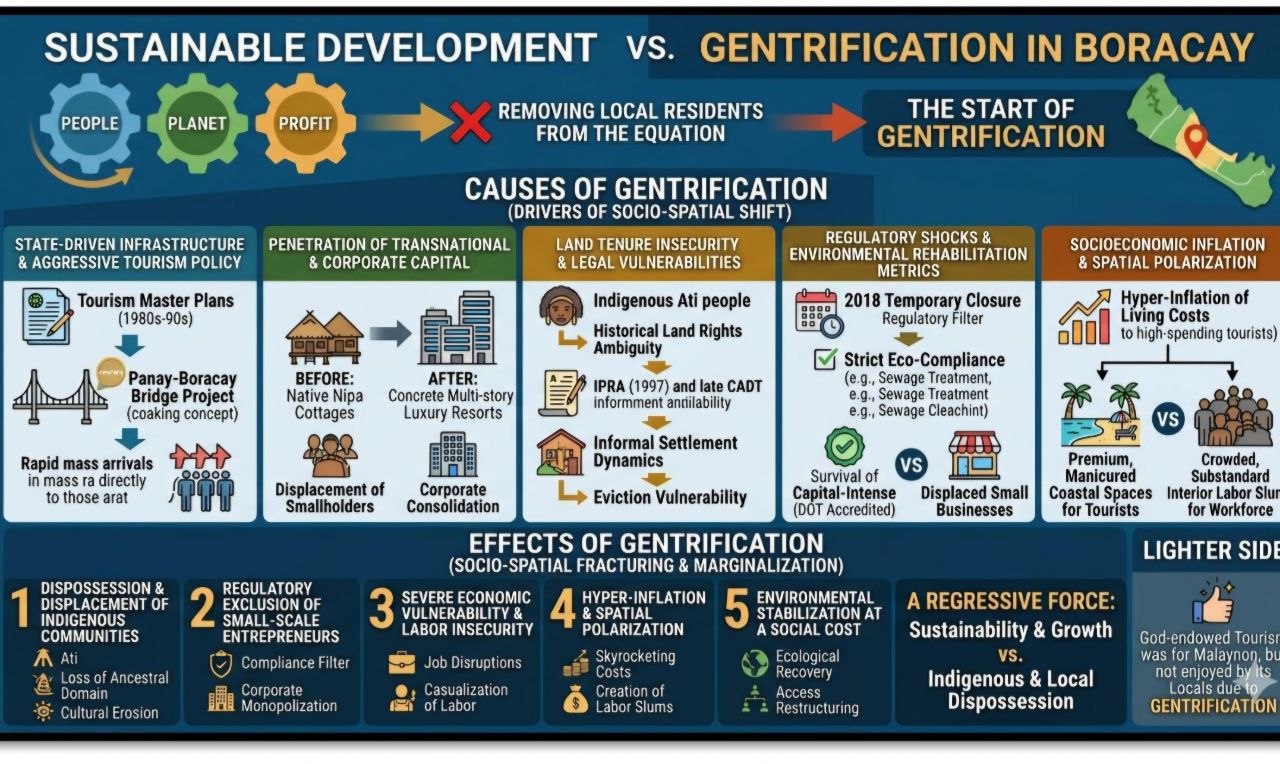
Sustainable Development cannot be without the People, Planet, and Profit. In This basic
definition, people plays a major role in the sustenance of the environment and the socio-economic
progress. What if people or the residents of Boracay will be out of the equation? Then that’s
gentrification starts.
Gentrification is the transformation of working-class or vacant urban areas into middle
class residential and/or commercial spaces, involving the replacement of lower-income residents
with higher-income populations and reinvestment in the built environment.
The gentrification of Boracay Island represents a classic case of tourism-induced
gentrification (or tourismgentrification), where rapid commercialization transforms a
subsistence-based, indigenous ecosystem into a hyper-commodified, high-end global destination.
Unlike urban gentrification, which is typically driven by residential real estate shifts,
Boracay’s structural transformation has been fueled primarily by external capital, changing
governance paradigms, and global consumption patterns. The primary drivers behind this socio
spatial shift include the following interconnected factors:
First, State-Driven Infrastructure and Aggressive Tourism Policy
The foundational catalyst for gentrification was the shift from local, organic tourism to
state-sanctioned, mass-market development.The Tourism Master Plans. Initiated as early as the
late 1980s and 1990s, national frameworks systematically upgraded the island’s infrastructure
introducing stable electrification, submarine water pipelines, and improved transport networks
linked to mainland Panay (Caticlan and Kalibo). The Panay-Boracay Bridge Project. Ongoing
large-scale connectivity projects lower the geographic and logistical barriers for mass arrival,
fundamentally changing the scale of real estate demand and drawing corporate conglomerates that
outcompete local lodge operators.
Second, Penetration of Transnational and Corporate Capital
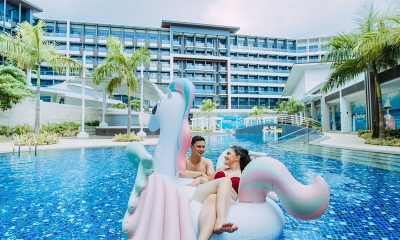
As the island’s global profile rose, the built environment underwent a drastic material shift
from native-style, small-scale accommodations (nipa and bamboo cottages) to concrete, multi
story luxury resorts. Displacement of Smallholders. High-capital domestic and foreign investors
acquired premium beachfront properties along White Beach (Stations 1, 2, and 3).Corporate
Consolidation. Indigenous families and early local entrepreneurs who lacked the capital to meet
modern building codes, formal international standard accreditations, or competitive marketing
demands were gradually bought out or pushed to the interior hinterlands.
Third, Land Tenure Insecurity and Legal Vulnerabilities
A critical institutional driver of gentrification in Boracay is the historical ambiguity of land
rights, which disproportionately impacted the island’s original inhabitants.Marginalization of the
Indigenous Ati. Historically semi-nomadic hunter-gatherers, the Ati people held native titles but
lacked formal, state-recognized paper documentation. Despite the passage of the Indigenous
Peoples’ Rights Act (IPRA) of 1997, securing a Certificate of Ancestral Domain Title (CADT) took
over a decade, during which vast tracts of land were claimed, titled, and commercialized by non
Ati migrants and corporations. Informal Settlement Dynamics. Many long-term residents were
classified by state agencies or private claimants as informal settlers, rendering them highly
vulnerable to eviction as real estate values skyrocketed.
Fourth, Regulatory Shocks and Environmental Rehabilitation Metrics
Paradoxically, state interventions intended to mitigate environmental degradation have
accelerated the institutionalization and gentrification of the island. The 2018 Temporary Closure.
The six-month closure ordered for environmental rehabilitation acted as a massive regulatory filter.
Demolishing non-compliant structures within the 30-meter shoreline easement and enforcing strict
environmental compliance criteria (such as mandatory connection to decentralized sewage
treatment systems) created a high financial barrier to re-entry. Survival of the Capital-Intense
While well-capitalized, Department of Tourism (DOT)-accredited corporate enterprises possessed
the planned and adaptive resilience to absorb the financial losses of the closure and invest in
expensive compliance infrastructure, many low-income, informal sector workers and marginal
businesses were permanently displaced.
Lastly, Socioeconomic Inflation and Spatial Polarization
The transition from a subsistence fishing and agricultural economy to a monostructured
tourism economy has fundamentally reorganized local community dynamics. Hyper-Inflation of
Living Costs. The influx of high-spending international tourists (historically led by East Asian
and Western markets) drove up the cost of basic commodities, utilities, and real estate, making it
financially unsustainable for low-wage workers to reside in prime areas. Creation of Labor Slums.
Due to a mismatch between tourist-centric spaces and affordable housing, the island experienced
an uncontrolled influx of labor migrants from surrounding provinces. This created a highly
polarized spatial structure: premium, manicured coastal spaces for tourists, contrasted with
crowded, substandard interior settlements for the workforce.The Post-Rehabilitation Matrix.
Modern governance frameworks on the island utilize strict carrying capacities (capping daily
tourist and worker volumes). While highly effective at slowing ecological degradation, these
ceilings naturally turn access into a premium commodity—further solidifying Boracay’s evolution
from an egalitarian backpacker haven into an exclusive, highly regulated luxury destination.
The gentrification of Boracay Island has radically transformed its social fabric, spatial
layout, and economic structure. While tourism development and strict state regulations have
successfully restored the island’s physical environment, they have simultaneously produced deep
socio-spatial fracturing and marginalization for the local community.
The primary consequences of this transformation manifest across several distinct areas:
1. Dispossession and Displacement of Indigenous Communities
The most severe social consequence has been borne by the island’s original inhabitants,
particularly the indigenous Ati people.
• Loss of Ancestral Domain.Historically semi-nomadic, the Ati were systematically pushed
off beachfront areas and prime agricultural lands into small, isolated pockets of the island.
Even after securing a Certificate of Ancestral Domain Title (CADT) for a 2.1-hectare
plot—one of the smallest in the country—they continue to face legal challenges, land
encroachment, and physical fencing by corporate developers.
• Cultural Erosion. Forced integration into a hyper-commercialized economy has
dismantled traditional hunting, gathering, and fishing practices, turning a once self
sufficient culture into one dependent on low-wage, informal tourism labor.
2. Regulatory Exclusion of Small-Scale Entrepreneurs
The post-2018 environmental rehabilitation governance framework altered the business
landscape by establishing a high financial barrier to entry.
• The “Compliance Filter”. Enforcing strict codes—such as mandatory connections to
decentralized sewage treatment plants and the demolition of structures within the 30-meter
shoreline easement—disproportionately harmed small, family-owned guest houses, local
eateries, and souvenir vendors.
• Corporate Monopolization. Lacking the liquid capital to absorb months of closure or
build expensive eco-compliant infrastructure, many local entrepreneurs sold out to
domestic conglomerates or foreign investors. As a result, the economy shifted from
decentralized local ownership to a consolidated corporate landscape.
3. Severe Economic Vulnerability and Labor Insecurity
The transition to a rigid, monostructured tourism economy created sharp economic
volatility for the island’s workforce.
• Massive Job Disruptions. The temporary six-month closure in 2018 immediately
displaced approximately 36,000 formal and informal workers, exposing the fragility of
depending entirely on a single economic driver.
• The Casualization of Labor. Most local residents are restricted to low-tier, seasonal
service roles (construction, housekeeping, transport, and boat guiding) characterized by
low wages, lack of job security, and limited upward mobility, while high-paying managerial
positions are typically filled by professionals brought in from mainland provinces or
Manila.
4. Hyper-Inflation and Spatial Polarization
Gentrification has divided the island into distinct zones dictated by purchasing power.
• Skyrocketing Cost of Living. The prices of real estate, utilities, and daily commodities
have inflated to match international tourist standards, making the island financially hostile
for low-income residents.
• Creation of Interior “Labor Slums”. High beachfront land values have pushed the
workforce into dense, overcrowded, and underserved interior barangays. This creates a
stark spatial contrast between manicured, highly regulated luxury tourist zones and the
substandard living conditions of the individuals who service them.
5. Environmental Stabilization at a Social Cost
From an ecological standpoint, gentrification under strict state enforcement has yielded
undeniable environmental benefits, though distributed unevenly.
• Ecological Recovery. The enforcement of strict carrying capacities (capping tourist and
worker volumes) has successfully mitigated coliform bacteria levels, restored coral reefs,
and cleared beachfront overdevelopment.
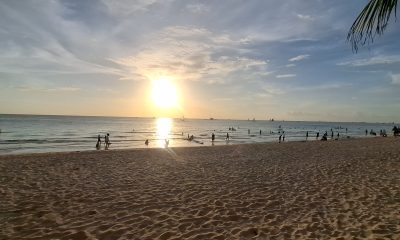
• Access Restructuring. The island’s beaches have been effectively “cleaned up” of local
vendors, fire-dancers, and micro-activities. While this presents a pristine aesthetic for high
paying travelers, it criminalizes the traditional, informal livelihood strategies that local
families relied upon for decades.
• Socio-Spatial Summary. The case of Boracay demonstrates that environmental
sustainability and tourism growth, when driven by top-down gentrification, often act as
regressive forces. The island has successfully transitioned from an over-capacity
“cesspool” into a model of regulated eco-tourism, but this success was achieved by pricing
out, displacing, and marginalizing the very community that sustained the island for
generations.
On the lighter side, Boracay Tourism has been endowed by God to be enjoyed by
Malaynon. But because of Gentrification, this gift was not enjoyed by its locals.