Commentary
When The Bridge is Dead, the Crisis Remains: Securing Boracay’s Ecological Frontier

By: Dr. Jimmy Maming
The social media have been flooded with the Boracay Bridge issues both from the perspectives of yes and nay sayers. There was a lot of speculations that Ramon Ang and the SMC proponents have been backed out for this controversial project. The looming concern is, since this project is no longer in the track, how can we position Boracay Island as a competitive and sustainable hub in the country?
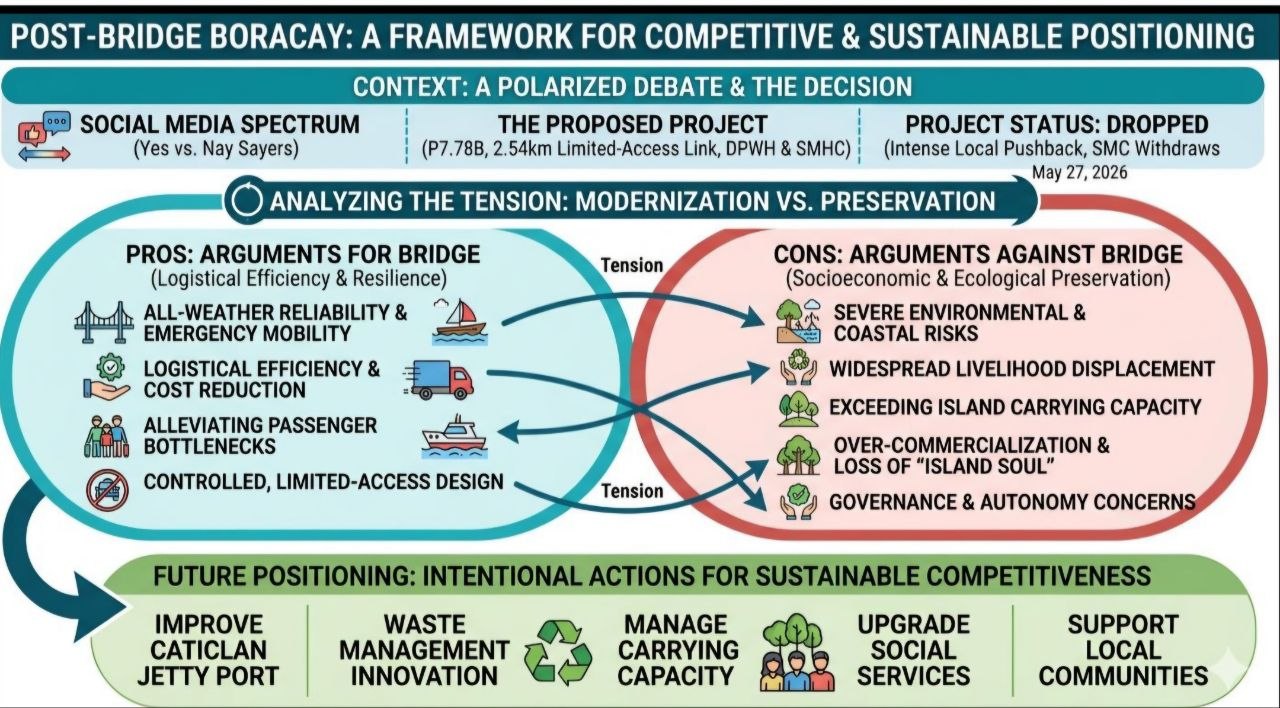
Apparently, the proposed ₱7.78-billion Boracay Bridge Project designed as a 2.54 kilometer limited-access link between Barangay Caticlan in mainland Malay and Boracay Island has been one of the most polarizing infrastructure debates in recent regional history (Panay News).
While the Department of Public Works and Highways (DPWH) formally issued a Notice of Award to San Miguel Holdings Corporation (SMHC) in March 2026, intense localized pushback culminated in San Miguel officially dropping the project on May 27, 2026, opting instead to prioritize mainland airport infrastructure (Inquirer.net)
Despite its cancellation, analyzing the core arguments for and against the land link highlights ongoing
tension between ecological/socioeconomic preservation (Inquirer.net).
The Pros:
Arguments for the Bridge infrastructural modernization and Proponents of the public-private partnership (PPP) initiative, including national infrastructure planners, emphasized long-term logistical efficiency and resilience:
All-Weather Reliability & Emergency Mobility. The primary operational benefit was an uninterrupted land link during inclement weather. Typhoons and southwest monsoon (habagat) rough seas regularly suspend ferry operations at the Caticlan Jetty Port, isolating the island. A bridge would ensure the seamless evacuation of sick or injured individuals and secure a 24/7 lifeline for emergency responders (The Manila Times).
Logistical Efficiency and Cost Reduction. Supplying a global tourism hub via maritime cargo is costly and labor-intensive. A direct vehicular link would streamline the delivery of fresh produce, building materials, and essential goods, while offering a more efficient, direct route for critical utilities like solid waste management transport and water/power infrastructure lines.
Alleviating Passenger Bottlenecks. For tourists, a land bridge would eliminate the multi stage transfer system (airport to jetty, jetty to boat, boat to island port), drastically shortening transit times and improving the overall visitor arrival experience (Panay News)
Controlled, Limited-Access Design. To counter critics, final project adjustments proposed a highly regulated structure rather than an open highway. It was not intended fo unrestricted private vehicular influx, but rather prioritized for mass public transport, electric shuttles, cargo logistics, and emergency services (Boracay Information – My Boracay Guide)
The Cons: Arguments Against the Bridge
The opposition to the bridge was comprehensive, uniting the Sangguniang Panlalawigan of Aklan, LGU-Malay, and the League of Municipalities of the Philippines (LMP-Aklan), environmental coalitions like the Boracay Foundation Inc. (BFI), and grassroots transport cooperatives (Inquirer.net)
Severe Environmental and Coastal Risks. The strait between Caticlan and Boracay features delicate marine ecosystems. Critics and environmental scientists warned that heavy marine construction, piling, and long-term structural placement would permanently disrupt coastal processes, including natural water circulation and critical sediment movement. There were deep fears that altering these currents could compromise the natural replenishment of Boracay’s famous white sand beaches (Boracay Information – My Boracay Guide)
Widespread Livelihood Displacement. The bridge posed an existential threat to the existing maritime transport economy. Thousands of families depend on the Caticlan-Boracay ferry system, including motorized outrigger boatmen, port porters, pumpboat cooperatives, and mainland tricycle drivers who manage the “middle mile” transport (Inquirer.net)
Exceeding the Island’s Carrying Capacity. Local leaders feared that eliminating the natural bottleneck of the ferry system would lead to unmanageable surges in tourist arrivals. An influx of daily visitors would severely strain Boracay’s fragile carrying capacity—overburdening the island’s drainage, sewerage, and solid waste management systems, which were painstakingly rehabilitated in 2018 (Inquirer.net)
Over-Commercialization and Loss of “Island Soul”. Many stakeholders argued that converting Boracay from a distinct island destination into a connected peninsula would dilute its unique aesthetic charm, turn limited land space into vehicular dead space (roads and parking), and accelerate aggressive big-box commercial development at the expense of local communities (Panay News).
Governance and Autonomy Concerns. A major point of contention was the perceived circumvention of local governance. The DPWH’s initial advancement of the unsolicited proposal lacked formal endorsement from the provincial board and local government units (LGUs), drawing criticism for prioritizing Manila-centric infrastructure models over localized, inclusive sustainable development (The Manila Times).
Ultimately, the structural risks to the ecosystem and the threat of economic displacement outweighed the logistical advantages of convenience. Following successive resolutions of disapproval from the Malay Sangguniang Bayan and the Aklan Provincial Board, San Miguel Corporation leadership withdrew the proposal to respect the unified stance of the local community (Inquirer.net).
But the challenging issues are still real. How will we plan and position Boracay Island as competitive global destination and its sustainability? Do we have a concrete plan to improve the main gateway- the Caticlan Jetty Port? How about the perennial issue on waste? How will we address the carrying capacity of the island to maximize the tourist arrivals? How will we address the basic social services like the local hospital? How will we improve the plight of the informal settlers on the island? These are my how’s now and this calls for intentional action from the concerned authorities and stakeholders.