Lifestyle
Why Ob-ob Hill Formation and the Batan Beach Sands are So Black?

By: Raymond Sucgang
Batan, Aklan – It turns out that the origin of the Ob-Ob hill traces back to an ancient volcano, believed to have erupted roughly about 5 to 15 million years ago. It is part of the Miocene epoch, which lasted from about 23 million to 5.3 million years ago.
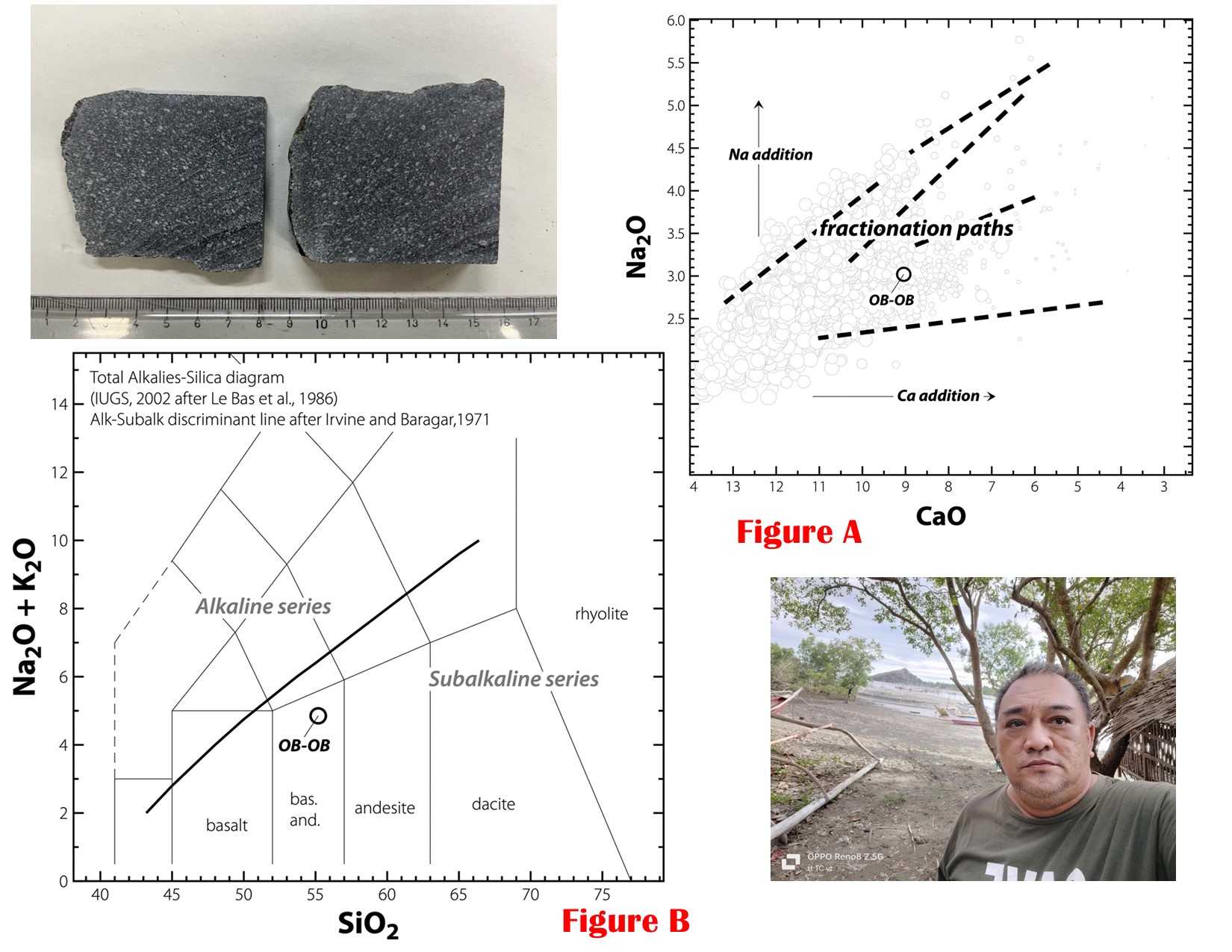
Here’s the narrative. Displayed in the upper left corner are rock samples extracted from the Ob-Ob hill, and analysed by Dr Americus Perez of PNRI, when he visited Batan sometime in November 2023. These samples underwent pulverization and analysis to determine their elemental composition using X-ray Fluorescence Spectrometry, Inductively Coupled Plasma-Mass Spectrometry, and Neutron Activation Analysis.
The initial inquiry was: Are these samples “fresh”? By “fresh,” we mean, does their elemental composition today match that of when they were ejected by the volcano millions of years ago? Have the rocks retained their elemental composition since ancient times? If the elemental composition has been modified by human activities or by exposure to seawater, or if it has been influenced by mixing with substances like cement or other pollutants, then there would be no point in analyzing the samples now, correct? Figure 1 provides the answer.
In Figure 1, the Oxide plots for sodium (Na) and calcium (Ca) are presented. If sodium levels were elevated due to external factors, we would anticipate a trend towards higher values on the Y-axis. Conversely, if calcium levels were increased due to “contamination,” the trend would shift towards the right along the X-axis. However, we observe that the Ob-Ob samples are positioned in a region where we can consider them as “fresh” or uncontaminated. This suggests that their current composition can be assumed to be the same as when they were ejected by the volcano. This implies that the analysis can proceed since the samples are considered “fresh.” The next inquiry is about the composition of materials constituting the Ob-Ob hill, which is elucidated in Figure 2. According to Figure 2, it consists of a mixture of basalt and andesite.
Basalt and andesite are both types of volcanic rocks with distinct compositions and characteristics:
Basalt is a DARK-COLORED volcanic rock that is fine-grained.
It is primarily composed of mafic minerals such as pyroxene, olivine, and plagioclase feldspar.
Basalt typically forms from lava flows on the Earth’s surface or from fissure eruptions.
It is commonly found in oceanic crust, volcanic islands, and in areas of recent volcanic activity.
Basalt is known for its high density and low viscosity, which means it can flow easily as lava when erupted.
Andesite is an intermediate volcanic rock that is typically light to DARK GRAY in color.
It is composed of minerals such as plagioclase feldspar, amphibole, and sometimes biotite.
Andesite forms from magma that has intermediate silica (silica is the main component of usual sand) content, between that of basalt and rhyolite.
It is commonly associated with SUBDUCTION ZONES, where oceanic crust is forced beneath continental crust.
Andesite lava flows are often viscous and can form steep-sided volcanoes or lava domes.
In short, basalt is a dark-colored volcanic rock formed from mafic lava flows, while andesite is an intermediate volcanic rock with a composition between basalt and rhyolite, often associated with SUBDUCTION ZONES.
Note the word I put in Bold letters. These will be intersting topics for the next Discussion: Is the Ob-ob ancient volcano similar to Mayon or Taal?
(The author is an outstanding Akeanon awardee in the field of science and technology)