Commentary
Boracay Bridge: A Boon or a Bane?

By: Leon Magpusao
Read. Comprehend. Empower
Boracay Bridge: A Boon or a Bane?
The Department of Environment and Natural Resources (DENR) the other day had given assurance that no decision on the controversial 2.54 kilometers Boracay Bridge project will be made without conducting a comprehensive public consultations and environmental review. The agency is emphasizing strict compliance with Boracay land use, zoning, and carrying capacity, especially under the new DENR Administrative Order 2026-36.
DENR had also informed that no environmental application has been filed so far by the San Miguel Holding Corporation.
Why is an environment review extremely necessary?
Boracay’s famous white sands are not accidental; they are rooted in the island’s geological and biological history, which indeed includes ancient coral systems.
Geological Foundation of Boracay
Boracay Island lies just off the northwest tip of Panay Island, separated by a narrow channel. Geologically, it is not a coral reef island (like some atolls), but rather a continental fragment, an extension of Panay’s landmass that has been uplifted and shaped over millions of years.
Bedrock: Not Coral, but Ancient Rock Formations
The core of Boracay consists mainly of:
* Sedimentary rocks (limestone, shale, sandstone)
* Metamorphic rocks (older rocks altered by heat and pressure)
These rocks formed long before the coral reefs and provided the structural “skeleton” of the island.
So strictly speaking:
Boracay is not built on coral beds, but coral plays a major role in what covers and surrounds it.
Coral Reefs as Sand Producers
Surrounding Boracay are living and fossil coral reef systems. Over time, corals, shells, and marine organisms (especially calcareous algae like Halimeda) break down. Waves grind these materials into fine white carbonate sand. Currents deposit this sand along the coastline, especially on White Beach.
This process is part of a broader scientific concept: carbonate sedimentation. It explains how tropical beaches like Boracay’s are formed, not from quartz (like many mainland beaches), but from biogenic materials.
Was Boracay once underwater?
Yes. Partly submerged in the past. Geological evidence suggests that:
* Parts of Boracay were once submerged under shallow seas
* Coral reefs grew along its edges during higher sea levels
* Over time, tectonic uplift and sea-level changes exposed the island
This connects to another key concept: tectonic uplift. Because of uplift, what used to be near-shore reef environments may now be:
* Elevated limestone areas
* Coastal terraces
* Fossil coral deposits inland.
So while the island is not purely a “coral bed,” it contains remnants of ancient reef environments.
Why This Matters Today?
Understanding Boracay’s geological nature explains why it is so environmentally fragile.
A Dynamic, Living System
The white sand depends on:
* Healthy coral reefs offshore
* Seagrass beds that stabilize sediments
* Balanced wave and current patterns
Disruptions, like dredging, coastal construction, or changes in water flow, can:
* Reduce sand production
* Cause erosion
* Permanently alter the beach
Bottom Line:
Boracay is geologically part of Panay, not a standalone coral island. However, its surface environment and beaches are heavily dependent on coral reef systems.
In a sense, the island does not sit on coral, but its beauty is built by coral.
To understand the possible impact of a bridge, it helps to first complete the picture of why Boracay’s white beach is so unique and so vulnerable.
Why is Boracay’s sand exceptionally fine?
The powdery texture of Boracay Island, especially along its western coastline, comes from a very specific natural system:
1. Biogenic (Living-Origin) Sand
Unlike many beaches made of ground rock (quartz), Boracay’s sand is largely:
*Crushed coral skeletons
* Shell fragments
* Calcareous algae (like Halimeda)
These materials are continuously produced offshore through carbonate sedimentation.
This is why the sand is:
* Brilliant white (calcium carbonate reflects light)
* Extremely fine (broken down over long periods by wave action)
2. Reef–Seagrass–Wave Balance
The famous White Beach exists because of a delicate interaction:
* Coral reefs → produce carbonate material
* Seagrass beds → trap and stabilize sediments
* Gentle wave energy (west-facing side) → slowly deposit sand instead of washing it away
Even small disturbances in this system can disrupt sand supply.
Where does the bridge enter the picture?
The proposed Boracay–Panay bridge would cross the narrow channel between Boracay Island and Panay Island. While the structure itself may not sit directly on White Beach, its indirect effects could propagate across the entire coastal system.
Potential Environmental Impacts on the Marine Ecosystem
1. Disruption of Currents and Sediment Flow
Bridge piers and embankments can alter tidal and wave patterns. Currents that carry fine carbonate sand toward White Beach may weaken or shift. Sediments could accumulate in the wrong areas or be carried away entirely.
Long-term effect: beach thinning or uneven erosion.
This is particularly critical because Boracay’s sand are not replenished from rivers; they rely almost entirely on reef-derived material.
2. Damage to Coral Reefs During Construction
Construction activities such as:
* Pile driving
* Dredging
* Reclamation
can directly harm reefs.
Impacts include:
* Physical breakage of coral structures
* Increased water turbidity blocking sunlight
* Smothering of corals by suspended sediments
Since coral reefs are the primary “factories” of Boracay’s sand, their damage reduces future sand supply.
3. Seagrass Degradation
Seagrass beds, often overlooked, play a crucial role:
* They trap fine sediments
* They prevent sand from being washed away
Disturbances from construction or altered water flow can:
* Uproot seagrass
* Reduce sediment stability
* Accelerate coastal erosion
4. Water Quality Decline
A bridge typically leads to increased traffic and development.
Possible effects:
* Oil and chemical runoff from vehicles entering the sea
* Increased sewage load due to higher tourist capacity
* Greater risk of algal blooms
These can trigger coral stress and bleaching, affecting the broader marine ecosystem.
5. Loss of Natural “Island Buffer”
Boracay’s current isolation acts as a natural regulator:
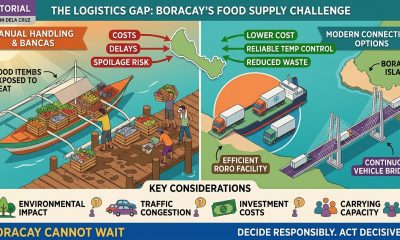
* Visitor flow is limited by boat transport
* Resource use is indirectly controlled
A fixed bridge removes this buffer:
* Easier access → higher tourist volume
* More pressure on water, waste, and coastal systems
The result could be a return to the environmental stress that led to Boracay’s 2018 rehabilitation.
Implications for White Beach Itself
Even if no construction occurs directly along White Beach, the system is interconnected.
Possible long-term outcomes:
* Sand coarsening (loss of the fine, powdery texture)
* Beach narrowing due to erosion
* Localized dead zones offshore where coral once thrived
* Gradual decline in the “aesthetic quality” that defines Boracay
In short:
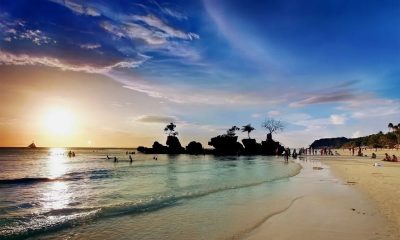
The beach may still exist, but no longer in the form that made it world-famous.
Social and Ecological Interdependence
Environmental degradation does not occur in isolation. Fisherfolk may lose reef-based livelihoods. Tourism workers may suffer if beach quality declines. Indigenous and long-time residents – already marginalized – may face further displacement as land values shift and ecosystems degrade.
A Delicate Equation
Boracay’s beauty is not static. It is the result of a living, self-sustaining coastal system that depends on:
* Healthy coral reefs
* Stable seagrass beds
* Undisturbed sediment movement
A bridge introduces a permanent, large-scale alteration to that system.
Final Insight –
The key issue is not whether a bridge can be engineered; it can.
The real question is whether the ecosystem that created Boracay’s white sand can continue to function under that new reality.
Because once that system is disrupted, the loss is not just environmental; it is geological, economic, and cultural, and may take centuries to reverse, if it can be reversed at all.