Latest News
Top Ten Areas in the Philippines with the Most Reported Brownouts in 2026

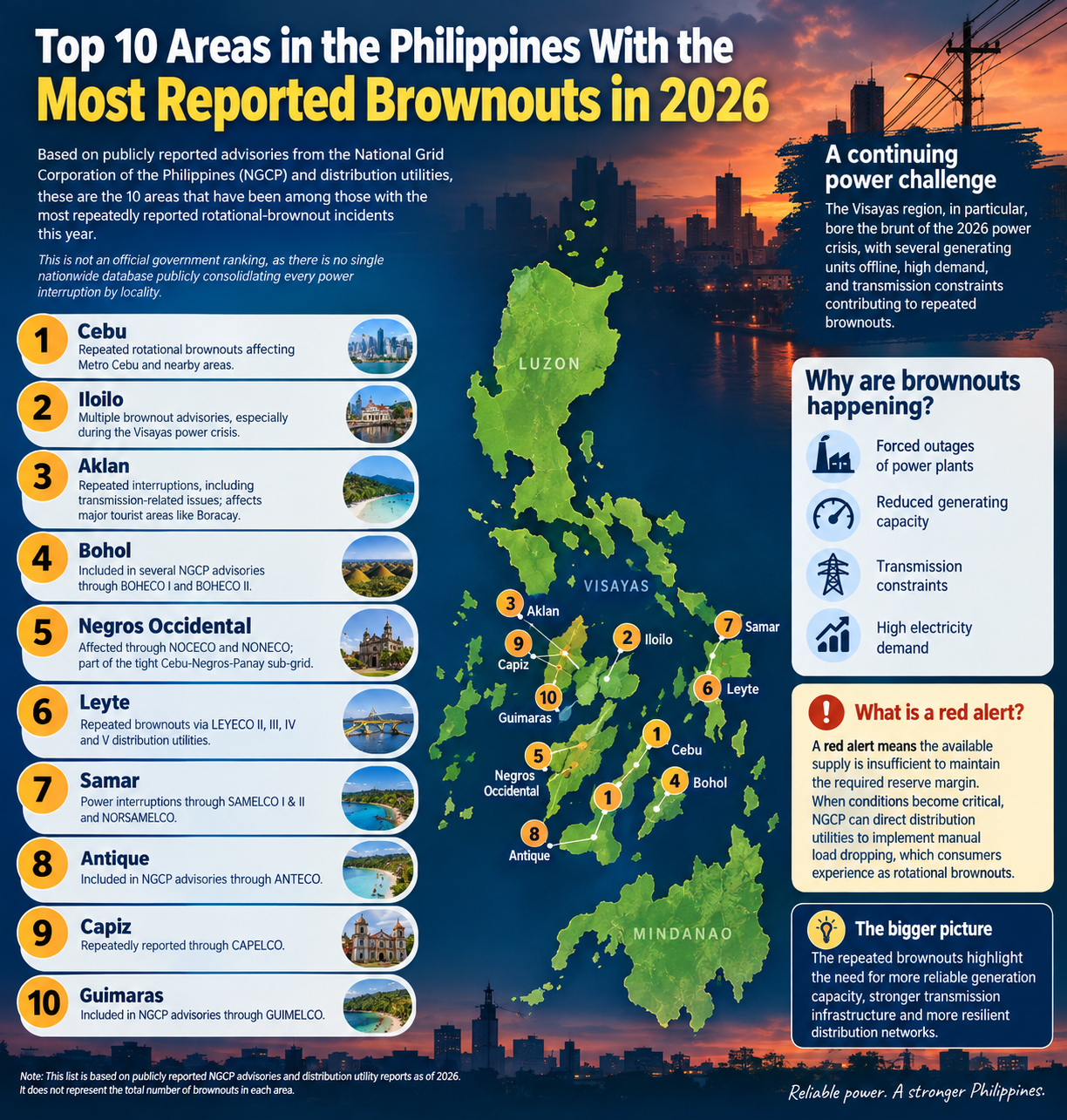
Repeated power interruptions have affected communities across the country in 2026, with the Visayas emerging as one of the hardest-hit regions amid tight electricity reserves, forced power-plant outages and transmission constraints.
Based on publicly reported advisories from the National Grid Corporation of the Philippines (NGCP) and reports from distribution utilities, the following areas have been among those with the most repeatedly reported rotational-brownout incidents this year.
The list is based on the frequency of publicly reported rotational-brownout advisories and should not be considered an official government ranking, since there is no single nationwide database publicly consolidating every power interruption by locality.
1. Cebu
Cebu has emerged as one of the most frequently affected areas in 2026.
NGCP repeatedly warned of possible manual load dropping involving distribution utilities serving Cebu, including Visayan Electric and the Cebu Electric Cooperative utilities.
Metro Cebu experienced additional rotational brownouts in August, including interruptions affecting more than 100 areas. NGCP again warned of possible rotating outages in September as the Visayas Grid remained under severe supply pressure.
2. Iloilo
Iloilo has also experienced repeated rotational brownouts as the Visayas Grid struggled with limited generation.
MORE Power and other Iloilo distribution utilities were repeatedly included in NGCP’s manual-load-dropping advisories.
The situation remained a concern into September. Iloilo City officials were considering new generation projects, including a proposed liquefied-natural-gas-to-power facility, as rotational brownouts continued to affect the city and surrounding areas.
3. Aklan
Aklan has experienced repeated power interruptions involving both supply shortages and transmission-related problems.
AKELCO was among the distribution utilities repeatedly included in NGCP’s rotational-brownout advisories during the Visayas power crisis. Aklan also experienced separate scheduled and transmission-related interruptions during the year.
The province’s power situation has been particularly significant because of its impact on major tourism destinations, including Boracay.
4. Bohol
Bohol was repeatedly included in NGCP’s Visayas rotational-brownout advisories through BOHECO I and BOHECO II.
The province was among the areas affected when the Visayas Grid faced insufficient reserves during periods of high demand and multiple generating-plant outages.
5. Negros Occidental
Areas of Negros Occidental were repeatedly affected through distribution utilities including NOCECO and NONECO.
The province was part of the Cebu-Negros-Panay sub-grid, which experienced particularly tight supply conditions during several periods of the year.
NGCP cited limited generation in the sub-grid when it implemented manual load dropping during the June power crisis.
6. Leyte
Leyte was another repeatedly reported brownout area, with several distribution utilities—including LEYECO II, III, IV and V—appearing in NGCP advisories.
The repeated interruptions occurred as the wider Visayas Grid struggled with insufficient reserves.
7. Samar
Samar also experienced repeated power-supply problems, with distribution utilities including SAMELCO I and II and NORSAMELCO appearing in rotational-brownout advisories.
The interruptions were part of broader efforts to stabilize the Visayas Grid whenever available generation fell below the required reserve level.
8. Antique
Antique, served principally by ANTECO, was also repeatedly included in NGCP’s rotational-brownout advisories.
The province was among the areas affected during the May power crisis, when several major generating units were unavailable and electricity demand remained high.
9. Capiz
Capiz, through CAPELCO, was repeatedly identified in Visayas rotational-brownout advisories.
The province experienced interruptions as NGCP implemented manual load dropping to protect the stability of the grid during periods when generation could not adequately meet demand.
10. Guimaras
Guimaras, served by GUIMELCO, was also repeatedly included in NGCP advisories for possible rotational brownouts.
The province was among several Western Visayas areas affected by the power-supply shortage that hit the region during the summer months.
Visayas bears the brunt of the power crisis
The concentration of most of the areas on the list in the Visayas reflects the seriousness of the region’s electricity shortage in 2026.
On May 13, NGCP placed the Visayas Grid under red alert after several major generating units went offline. The grid operator warned that manual load dropping could be necessary to prevent the system from becoming unstable.
The following days saw repeated rotational brownouts. On May 16, Luzon and the Visayas were placed under red alert for the third consecutive day, with consumers experiencing outages lasting about two to three hours in affected areas.
On May 29, NGCP again warned of rotating brownouts across numerous Visayas distribution areas, including utilities serving Cebu, Negros, Iloilo, Aklan, Antique, Capiz, Guimaras and Bohol.
The power problem continued beyond the summer months. In September, NGCP again warned that rotational outages could be implemented across several Visayas areas because of limited generation and the absence of imported electricity from the Mindanao Grid.
Why are brownouts happening?
The recurring interruptions have been linked to several factors, including forced outages of power plants, reduced generating capacity, transmission constraints and high electricity demand.
During the May crisis, NGCP reported that numerous generating units were unavailable, leaving the Visayas Grid with very limited reserves. Reuters reported that 27 power plants had gone offline by mid-May, contributing to serious electricity shortages in the country’s major grids.
The situation became particularly serious when several large generating facilities in the Visayas were simultaneously unavailable.
A red alert means the available supply is insufficient to maintain the required reserve margin. When conditions become critical, NGCP can direct distribution utilities to implement manual load dropping, commonly experienced by consumers as rotational brownouts.
No official nationwide Top 10
The list should be viewed as a media-based ranking of areas with repeatedly reported brownout incidents, rather than an official DOE or NGCP ranking.
The actual number of interruptions experienced by consumers may be higher because local distribution utilities also conduct scheduled maintenance and experience outages caused by equipment failures, weather and other localized problems.
Nevertheless, the repeated appearance of these areas in NGCP and distribution-utility advisories shows the continuing pressure on the country’s electricity system.
For consumers and businesses, the recurring brownouts underscore the need for additional reliable generation capacity, stronger transmission infrastructure and more resilient distribution networks.
As the country heads toward the latter part of 2026, the continuing power shortages in parts of the Visayas remain a major concern for households, businesses and tourism-dependent communities.