Latest News
Discrimination and Privacy Case Vs.Philippine Government Brought to UN Women’s Rights Committee

 1
1
Communication filed under CEDAW Optional Protocol assails Supreme Court’s Second Division’s non-consensual outing of litigant, discriminatory application of the Family Code, and the continued delegitimization of same-sex unions in the Philippines
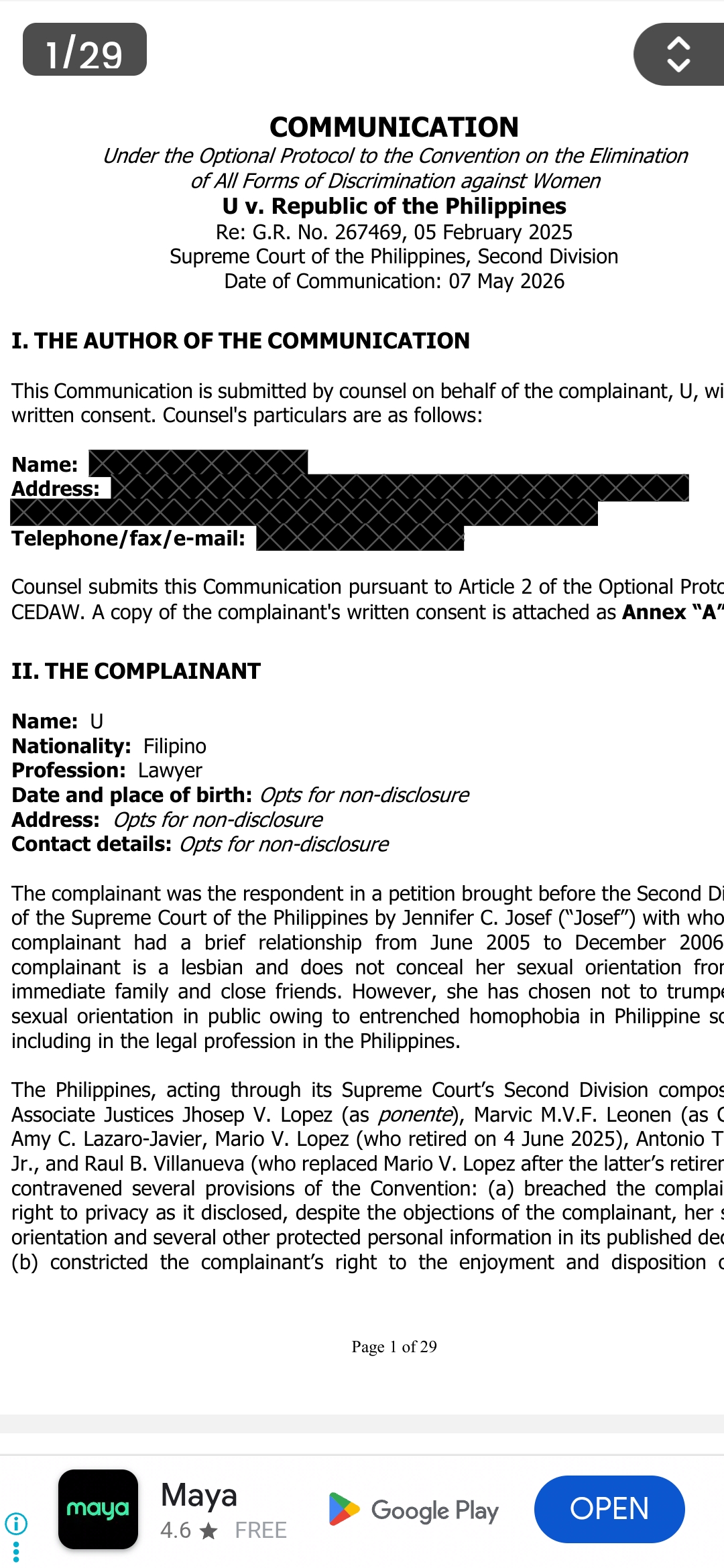
Manila,—A Filipina complainant filed a communication against the Philippine government before the United Nations Committee on the Elimination of Discrimination against Women (CEDAW Committee) on 8 May 2026, assailing the Supreme Court’s Second Division for exposing her sexual orientation, complete name, and home address in a published decision over her objections as well as the discriminatory application of the Family Code of the Philippines to her property relations.
The allegations against the Philippine government, acting through the Supreme Court’s Second Division, stem from a property dispute between the complainant and her former partner, instituted by the latter in 2015 through a lawsuit seeking the partitioning of the complainant’s home between the two of them.
The trial court and the Court of Appeals concluded that the complainant’s former partner failed to produce evidence that a co-ownership was established between the parties, citing that the latter failed to produce any evidence of actual contribution to the acquisition or upkeep of the property. Both tribunals also found that the former partner’s sole evidence was forged.
Having been repeatedly unsuccessful up to the appellate court, the former partner lodged a final appeal before the Supreme Court’s Second Division, arguing for the first time that Article 148 of the Family Code, which governs the property relations of parties who cohabited but were incapacitated to marry each other, should apply in her and the complainant’s case.
The Supreme Court’s Second Division decided in favor of the former partner, ruling that Article 148 of the Family Code applies in the case of the parties and ordered that the case be remanded to the trial court.
The complainant, however, asserts that the Supreme Court’s Second Division was wrong in applying the cited provision of the Family Code and that it glossed over important facts including that the former partner has presented no proof of actual joint contribution, as affirmed by the trial court and the Court of Appeals, and that the sole document she produced to claim a 50% stake on the complainant’s home was falsely notarized.
She also alleges in the communication that “repurposing” Article 148 of the Family Code, the entire structure of which is “heteronormative”, that is, framed around unions between men and women, only further affirmed that women in same-sex relationships cannot ever be capacitated to marry and, hence, constitutes a violation of the Philippines’ obligation under the Convention on the Elimination of All Forms of Discrimination Against Women (CEDAW)
Non-consensual outing of litigant
The complainant’s communication to the CEDAW Committee also argues that the disclosure of her complete name, home address, and sexual orientation in the high court’s published decision constitutes a privacy violation and triggers a wider chilling effect that dissuades persons from the LGBTQIA+ community from seeking recourse for rights violations or defending their interests before the courts.
In an unpublished per curiam resolution, the Supreme Court’s Second Division denied the complainant’s plea for the protection of her right to privacy, where the complainant objected to the publication of her full name in a decision that discloses not only her sexual orientation, but also her complete home address, among others.
The communication asserts: “A litigant who discloses sensitive personal information, including her sexual orientation, in pleadings to either seek judicial relief or defend herself in a suit does not thereby consent to the public dissemination of that information by the court itself. To hold otherwise would mean that any woman who seeks judicial remedies in a matter touching on her sexual orientation forfeits, by that very act, her right to control who knows it. Such posture violates a woman’s right to privacy and exudes a chilling effect on the right to seek effective judicial remedies and, accordingly, constricts her access to the courts.”
It also asserts that the privacy violation is inseparable from the broader failure of the Philippines to confront its discriminatory legal framework for family and property relations. The communication underlines:
“To meet its obligations under Article 16 of the Convention, the Philippines needs to reframe an entire legal framework and not simply retool a handful of provisions of the Family Code. In performing the latter, the Philippines, acting through the Supreme Court’s Second Division, far from facilitating broader legal recognition of same-sex unions, not only defers a confrontation with a discriminatory legal framework indefinitely, but also further embeds same-sex unions along the margins of Philippine law.”
Discriminatory application of the Family Code and impact on women’s autonomy
The Supreme Court’s decision reversed 10 years of rulings in the complainant’s favor rendered by a trial court and the Court of Appeals, both of which found that the opposing party had produced no proof of contribution to the property in question and had submitted a falsified document as her primary evidence. The high court’s Second Division overturned these concurring findings by invoking, for the first time, Article 148 of the Family Code to govern the property relations of a former same-sex couple.
The communication asserts that Philippine jurisprudence has historically reserved Article 148 of the Family Code for bigamous marriages, adulterous relationships, and unions between persons who are incapacitated to marry. By invoking this provision for same-sex unions, the court assigns them to the legal category of illicit and illegal heterosexual relations, not to any recognized form of legitimate union.
Thus, the communication argues that the Philippines is in continuing breach of its obligations to accord women, including those in non-heterosexual relationships, equal rights in all matters relating to marriage and family relations.
“What resulted from the piecemeal tinkering with the policy architecture of the Family Code to accommodate [the former partner’s] individual cause is a firmer disavowal of same-sex unions and a constraint on the autonomy of women in same-sex relationships to manage or administer their property without the protections accorded by law to persons in heterosexual unions.”
While hailed among some quarters as a recognition of same-sex couples’ rights, the complainant claims that the high court’s ruling is not, by any true, enduring means, a progressive decision but a regressive view on women’s autonomy as it circumscribes a woman’s agency in determining the establishment of familial relationships with legal implications.
“For every woman in a same-sex relationship in the Philippines, the decision is not a shield, but a novel risk — to property claims asserted without proof of contribution, to cohabitation presumed from mere shared dwelling, to denial of established legal protections… and to the burdens of a legal regime that constrains her autonomy to shape the contours of her relationship and to decide how much of what she has she is willing to share to the union.”
Measures sought
The Filipina complainant requests that the CEDAW Committee find that the Philippine government, acting through the Supreme Court’s Second Division, is in violation of Articles 1, 2(c), 2(d), 2(f), 3, 15(1), 15(2), and 16(1)(h) of the Convention. It further requests for the complainant’s immediate anonymization of the published decision and adequate compensation for her legal costs and reputational and psychological harm, among others.
For similarly situated women, it calls for legislation formally recognizing same-sex unions with protections equivalent to those available under the Family Code, and for explicit procedural rules protecting the right to privacy of sexual orientation in Philippine court proceedings.
As an interim measure, counsel requests that the Committee transmit to the Philippines an urgent request for the removal of the complainant’s identifying information from the Supreme Court’s official website pending the outcome of the proceedings.
The Philippines ratified CEDAW on 05 August 1981 and acceded to the Optional Protocol on 12 February 2003. #