Commentary
Rethinking the ‘Parents Welfare Act’

By Chantal Jade V. Tolores
In a country that proudly brands itself as family-centered, the sight of elderly Filipinos begging on the streets or dying alone in public hospitals is a betrayal of the very values we claim to uphold. In response,
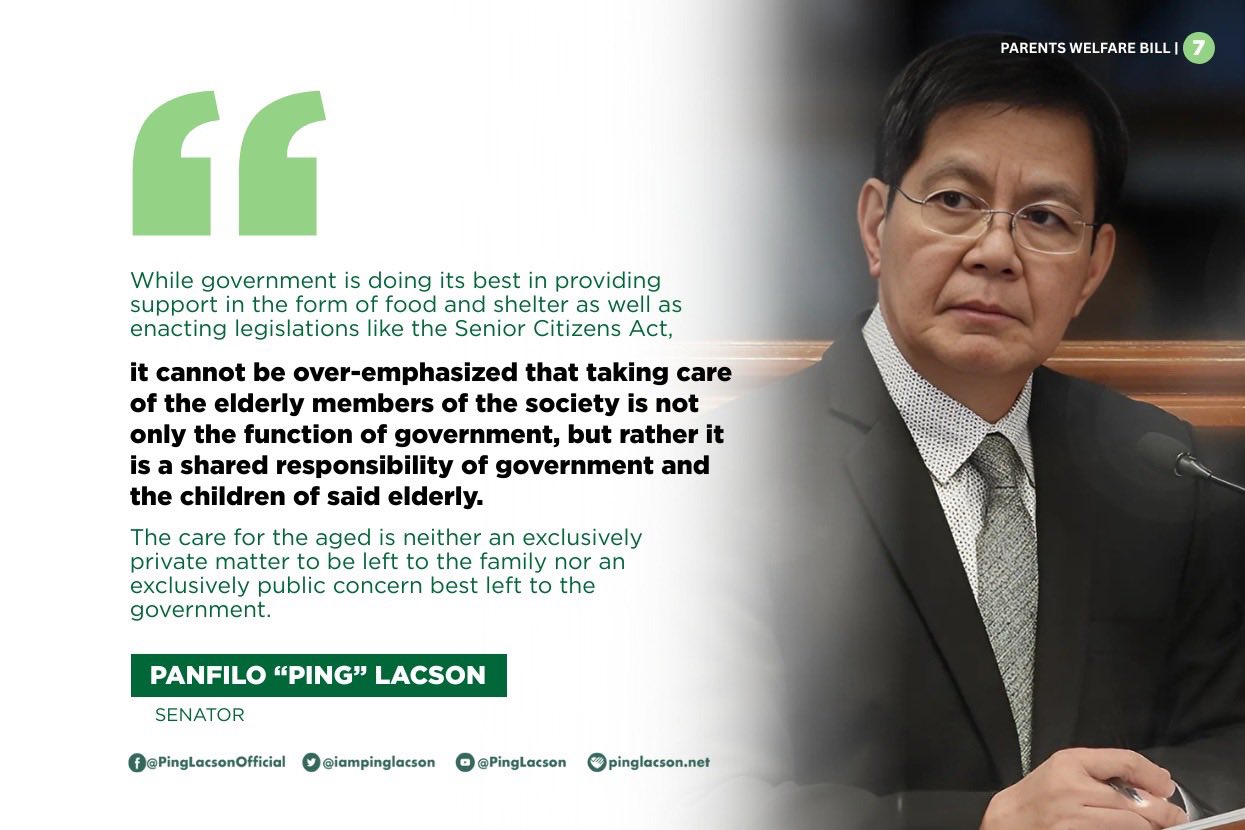
Senator Ping Lacson has refiled Senate Bill No. 396, the Parents Welfare Act of 2025, which seeks to penalize adult children who abandon or neglect their elderly parents. On its face, the bill seems like a solution to a worsening social problem. But while its intentions are honorable, it’s also a punitive one, may not be the most just, nor the most effective.
The Law Seeks Accountability. But Whose? The bill defines two offenses: first, the failure to support elderly, indigent, or incapacitated parents without justifiable cause, and second, outright abandonment. Violators can face imprisonment and hefty fines—₱100,000 for non-support, and up to ₱300,000 and ten years behind bars for abandonment. Many adult children disappear from their obligations once their parents grow frail or financially burdensome, which is a disturbing reality, and Lacson is right to be outraged.
But this proposed law may, unfortunately, become a hammer where a scalpel is needed. However, who are the people most likely to “abandon” their parents? Often, it’s not out of cruelty but out of incapacity. The adult child working two jobs to feed their children, the single mother already buried under debt, the family evicted for unpaid rent—these are the Filipinos who might fall short of their duty, not because they’re indifferent, but because they’re poor.
Will we imprison them for their poverty? Punishing people struggling to survive in an economy where multigenerational support is no longer sustainable is criminalizing poverty rather than addressing its root causes. If the State truly wants to protect senior citizens, it must create institutions that support elder care, not just enforce familial duty with an iron fist. Rather than penalize negligence alone, why not increase the SSS and GSIS pensions to livable levels? Why not strengthen PhilHealth’s coverage for senior citizens?
Why not establish government-subsidized nursing homes, day-care centers for the elderly, or programs that offer incentives to caregivers? Lacson’s bill does include the proposal of establishing at least one home for the aged in every province. That’s a good start, but without clear and immediate funding, the law becomes a blunt instrument—punitive, reactive, and insufficient. Moreover, Filipinos are taught from a young age to love and care for their elders. It’s a cultural strength, but we must be careful not to turn this into a weapon of guilt enshrined in law. Not all family relationships are built on love.
Some are shaped by decades of abuse, estrangement, or unresolved trauma. Forcing care through coercion may re-traumatize people or worsen toxic family dynamics. Instead of relying on courts to impose morality, we must build a system where caring for elders is a shared societal responsibility, with the State taking the lead, not just acting as the enforcer. Lacson’s proposal highlights an ugly reality that we’ve swept under the rug— our elderly is suffering, and too often, abandoned. He deserves credit for attempting to remedy it through legislation.
But to truly address this problem, our elderly deserves more than empty moralizing and courtroom drama. Filial love cannot be legislated, but safety and elder welfare can and should be.