Environment
Civil society groups urge new Japanese PM Takaichi: ditch fossil fuels, prioritize climate action and energy security in Asia


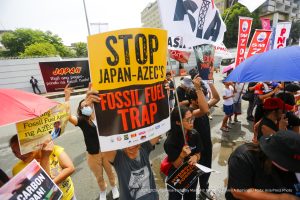
As the 3rd Asia Zero Emission Community (AZEC) Summit concludes in Kuala Lumpur today, October 28, 2025, civil society leaders hold a protest action in front of the Japanese Embassy in Manila calling on the new Prime Minister of Japan, Sanae Takaichi, to end Japan’s financing of fossil fuels and stop blocking Asia’s renewable energy transition.
Other protests are held in front of the Japanese Embassy in Malaysia, Indonesia and Australia calling out Japan’s leadership of the AZEC alliance, which they say promotes fossil fuel dependence rather than genuine decarbonization.
In a joint statement signed by 33 organizations, civil society groups called on Prime Minister Takaichi and ASEAN leaders to “take steps to ensure that AZEC becomes a genuine platform for accelerating the region’s clean energy future, not a vehicle to prolong fossil fuel use and corporate profits.”
“Japan is the world’s largest public financier of fossil fuels, and it is using AZEC to perpetuate fossil fuels at the expense of the energy security of, as well as public health in, Southeast Asia,” said Lidy Nacpil, coordinator of Asian Peoples’ Movement on Debt and Development (APMDD) and the Asian Energy Network (AEN).
Nacpil said “AZEC publicly brands itself as a clean energy initiative committed to zero emissions, but its actual agenda supports the expansion of fossil fuels through investment in liquefied natural gas (LNG), ammonia and hydrogen co-firing, and carbon capture and storage (CCS), which are technologies that pose environmental, economic, and social risks.”
According to APMDD, CCS is considered by many to be unproven and has a history of failure due to high costs, low capture rates, technical issues, and economic underperformance.
Nacpil said, “many proposed projects have been cancelled, while operating ones have chronically underperformed, with some even being used to produce more oil instead of reducing emissions.”
“LNG, CCS, and ammonia co-firing are expensive, dangerous distractions that keep us dependent on fossil fuels. They lock countries into long-term fossil fuel use, costly infrastructure, and debt. Meanwhile, Southeast Asia’s vast renewable potential remains untapped,” added Nacpil.
“We need genuine partnerships for renewable energy development, not financial schemes that serve Japanese corporate interests,” Nacpil said.
APMDD said “between March 2023 and October 2024, Japan has signed 217 memoranda of understanding (MoUs) under AZEC that aims to facilitate cooperation between governments and private companies covering a range of technologies from gas, LNG, and CCS to renewable energy like solar and wind. At the AZEC Ministerial Meeting on October 17, seven new MoUs were signed between Malaysian and Japanese entities, covering CCS, biofuels, and transition financing, including a CCS cooperation deal between Malaysia’s government and Japan’s Ministry of Economy, Trade, and Industry.”

APMDD said “Southeast Asia holds 99% of its renewable energy potential still untapped, with plans to increase capacity from 33.8 GW to 397.8 GW, a nearly twelvefold expansion. Campaigners say Japan should redirect its technological and financial resources toward realizing this potential.”
The mobilization in Manila was organized by Asian Peoples’ Movement on Debt and Development (APMDD), Philippine Movement for Climate Justice (PMCJ), Sanlakas, Oriang, Aniban ng Manggagawa ng Agrikultura (AMA), Kabuhayan Kalusugan Kalikasan Katiyakan sa Paninirahan (K4K QC), Bukluran ng Manggagawang Pilipino (BMP), Zone One Tondo Organization (ZOTO), and Kongreso ng Pagkakaisa ng Maralita ng Lungsod (KPML). /30
Photos by JIMMY A DOMINGO / MATA: Asia Press Photo