Commentary
A Tale of Science, Spirits, and Sobriety

By: Raymond Sucgang (Outstanding Akeanon Awardee)
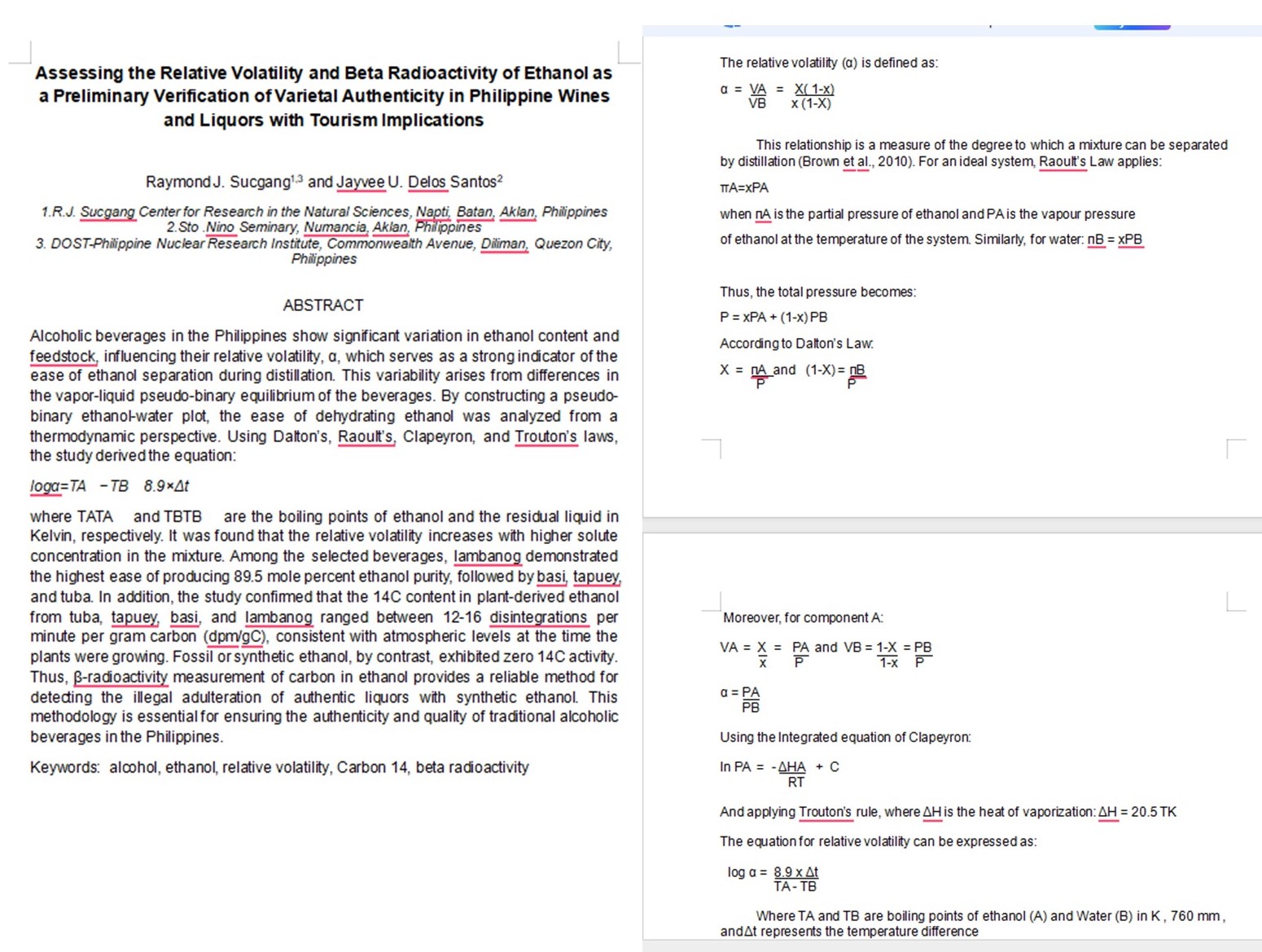
This paper was conceived under rather unconventional circumstances—over drinks with my co-author. As we indulged in some bottles of beer and sometimes other alcoholic beverages, we couldn’t help but marvel at the science behind them. Fueled by a few beers and boundless curiosity, we started calculating mentally, deriving key concepts and equations along the way.
Of course, I wouldn’t say we were drunk—let’s call it scientifically inspired. As my co -author would put it ” we were not drunkards , but merely drinkers,” And so, fueled by fermented wisdom, this paper was born.. Derive derive lang ng mga equations in the mind… And before we knew it, this paper was born—proof that good science can sometimes begin with good company and a bit of alcohol.
Philippine Alcohol: A Liquid Legacy
The Philippines offers a diverse range of traditional alcoholic beverages, each tied to local culture and customs. Tuba, a fermented coconut sap, is a favorite in the provinces, and when distilled, it becomes lambanog—a high-proof spirit. There’s also basi, a sugarcane wine aged in jars, and tapuy, a rice wine used in celebrations and rituals in the Cordillera region.
Though these drinks differ in flavor and strength, they all share a common scientific trait—the separation of ethanol from water through distillation. At first, we assumed the process would be simple, like a straightforward binary distillation. But reality isn’t that neat.
A Ternary Puzzle
The tricky part with traditional beverages is that they aren’t just binary mixtures of ethanol and water—they are ternary systems that also contain sugars, acids, flavor compounds, and other dissolved substances. These additional components make the separation of ethanol more complex.
During distillation, the composition of these drinks evolves. As some components vaporize and escape, what’s left behind behaves more like a binary system—but only at later stages. This shifting composition affects how efficiently ethanol separates from water and explains why certain beverages are easier to distill than others.
Applying Dalton’s, Raoult’s, and Other Laws
In the following days, in our actual experimentation, we used principles from Dalton’s Law and Raoult’s Law to understand how vapor pressures influence the distillation process. According to Raoult’s Law, the total vapor pressure of a liquid mixture is the sum of the vapor pressures of each component, weighted by their mole fractions. This helped us predict how much ethanol would evaporate at different points during distillation.
Meanwhile, Dalton’s Law explained the relationship between the partial pressure of ethanol in the vapor and its mole fraction in the liquid. As the concentration of ethanol increased in the vapor phase, it became easier to collect—at least initially, when the mixture still behaved as a ternary system.
The Clapeyron equation was used in understanding the temperature and pressure relationship during phase changes, while Trouton’s rule was used to estimate the heat of vaporization. All these laws came together to describe how ethanol behaves as it separates from complex mixtures.
The Experiment: Unraveling Volatility
Using fractional distillation, we heated samples of tuba, lambanog, basi, and tapuy to observe the behavior of ethanol. As the temperature rose, ethanol vaporized first, followed by water and other volatile components. We carefully monitored how the ethanol content in the vapor and the residue changed throughout the process.
We found that lambanog, being a distilled product, had the highest volatility and was the easiest to distill. In contrast, basi and tapuy posed more challenges—their sugars and other compounds slowed down the separation process. As distillation progressed and some components were removed, the mixture began to behave more like a binary system, making it easier to isolate ethanol in later stages.
Insights from a Night of Science and Spirits
The key takeaway from our study is that traditional alcoholic beverages aren’t as simple as they seem. Their ternary nature makes them more complicated to distill than ordinary ethanol-water mixtures. Yet, as distillation progresses, they transition toward binary behavior, helping us understand why some drinks, like lambanog, distill more efficiently than others.
So the next time you sip on tapuy or enjoy a shot of lambanog, remember that there’s science in every drop. Understanding these beverages requires more than just equations—it takes a mix of culture, chemistry, and, occasionally, a few beers with good company. And as our experience shows, sometimes the best insights come not from a laboratory, but from a shared drink and a curious mind.
Who knew that breaking down Dalton’s and Raoult’s laws could be so much fun? Cheers to science, tradition, and a night of spirited discoveries!