Commentary
COMELEC and Experts Urge Voter Caution on Online Polls by Local News Outlets

By: Guillermo Sumbiling
Calls Grow for Public Awareness on Misleading Election Surveys Ahead of 2025 Polls
KALIBO, Aklan – With the May 12, 2025 local and national elections drawing near, voters in Aklan are being encouraged to think critically about the information they encounter online—especially the growing number of so-called “surveys” being shared by local news outlets on social media.
Many of these online polls, often conducted informally through Facebook reactions or comment-based voting, are gaining popularity among netizens. However, they are raising serious concerns among election authorities and academic experts who warn that these surveys are unscientific, potentially misleading, and harmful to the democratic process.
Back in March 2022, the University of the Philippines (UP) School of Statistics released a strong public advisory, warning Filipinos about online surveys that lack proper methodology and credibility. According to UP, these surveys can distort public perception and influence voter decisions in ways that are not grounded in real data.
“These online polls are statistically unreliable,” the UP School of Statistics stated. “They do not use random sampling or controlled data collection, which means they do not reflect the views of the broader voting population. Voters must learn to question the credibility of such polls before accepting their results.”
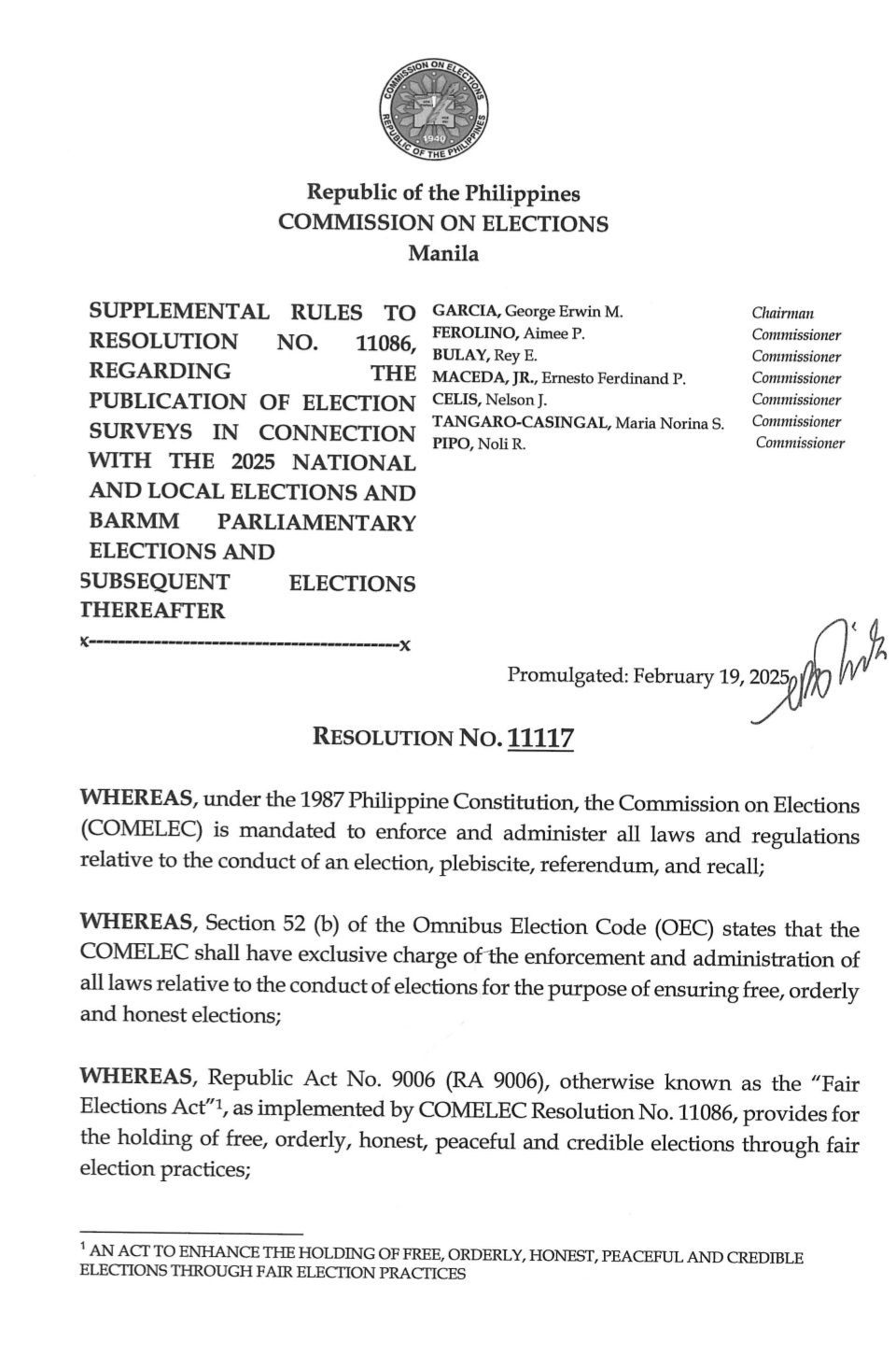
To reinforce responsible polling practices, the Commission on Elections (COMELEC) issued Resolution No. 11117 in February 2025, stating that only pre-registered and accredited organizations are allowed to conduct and release election surveys to the public. This regulation ensures that only legitimate survey firms, using credible methods, engage in public polling activities during the election period.
“COMELEC’s goal is to ensure that voters are not misled by questionable surveys,” the Commission said. “This is part of our effort to uphold fair and informed elections.”
Despite these regulations, many local news outlets continue to release online “surveys” without declaring official accreditation or explaining how results are gathered. These polls often go viral, leading to a bandwagon effect that may influence voters who are unaware of their limitations.
Voter education advocates are now calling for a stronger focus on media literacy during the election season.
“Voters have the power to shape our future, but only if they base their decisions on credible, factual information,” said a local educator in Kalibo. “Not all surveys are created equal. It’s important to ask: Who conducted this? Are they registered with COMELEC? How was the data collected?”
Experts also remind the public that social media popularity is not a reliable indicator of actual electoral support. Viral polls with thousands of shares or reactions do not reflect the diversity or complexity of the voting population.
As the campaign season intensifies, voters are urged to seek out trusted news sources, verify information, and be cautious of content that may be designed to manipulate opinion rather than inform it.
⸻
Tips for Voters: How to Spot a Credible Survey
• Check if the organization is registered with COMELEC.
• Look for clear information on how the survey was conducted.
• Be wary of surveys conducted through likes, shares, or comments.
• Don’t base your vote on online popularity—verify facts through reliable sources.
⸻
An informed voter is an empowered voter. As Election Day approaches, let’s ensure that our decisions are guided not by viral trends, but by truth, integrity, and critical thinking.